
A Trip to the Cananea Mines: What’s the Family Connection?
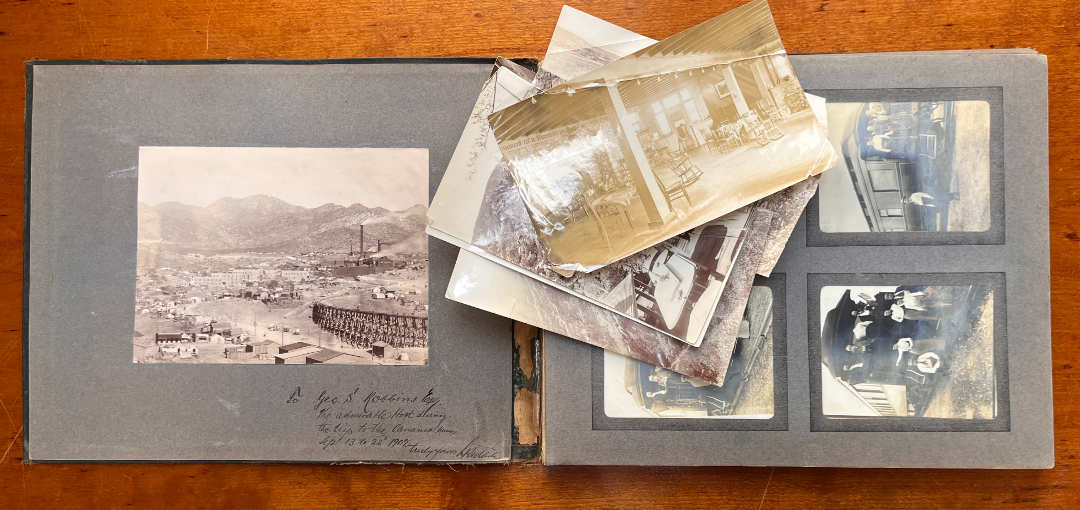
The Hagenbuch Archives are a rich source of family artifacts. However, the stories behind some of the items are not immediately apparent, nor are their connections to our Hagenbuch family.
A few months ago, while looking through a closet at my parents’ house, I noticed an old photo album. I opened it and found the pages filled with photographs of a trip, made by rail, into the West. I didn’t recognize anyone in the pictures, although there was an inscription inside the front cover of the album. It read:
To Geo. S. Robbins Esq.
The admirable host during the trip to the Cananea Mines.
Sept 13 to 23, 1902
Truly Yours, L. Reetlish
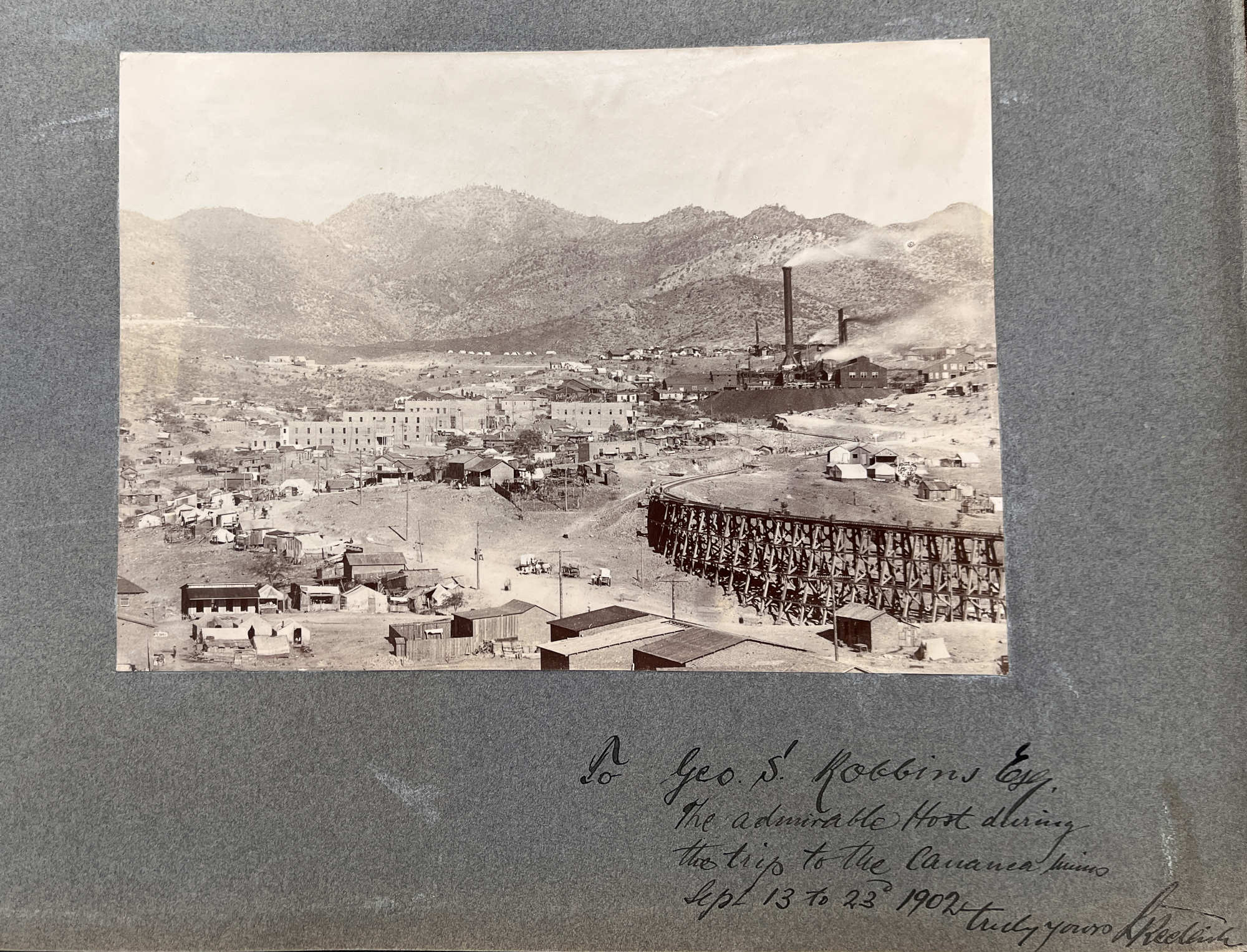
Portion of the inside cover of George S. Robbins Cananea Mines trip album. The photograph is of the Cananea Mines in Sonora, Mexico.
Again, none of these names rang a bell, so I put it back in the closet figuring it was unrelated to the Hagenbuchs. Upon returning home, I couldn’t stop thinking about the pictures and names in the album. Was there some obscure connection? Why did my father, Mark, have it with his things? I wanted to know more.
A week ago I asked my mother, Linda, to dig out the album and bring it to my sister’s place where some of us were gathering. I now had the book of photos in hand and could finally begin to uncover their history.
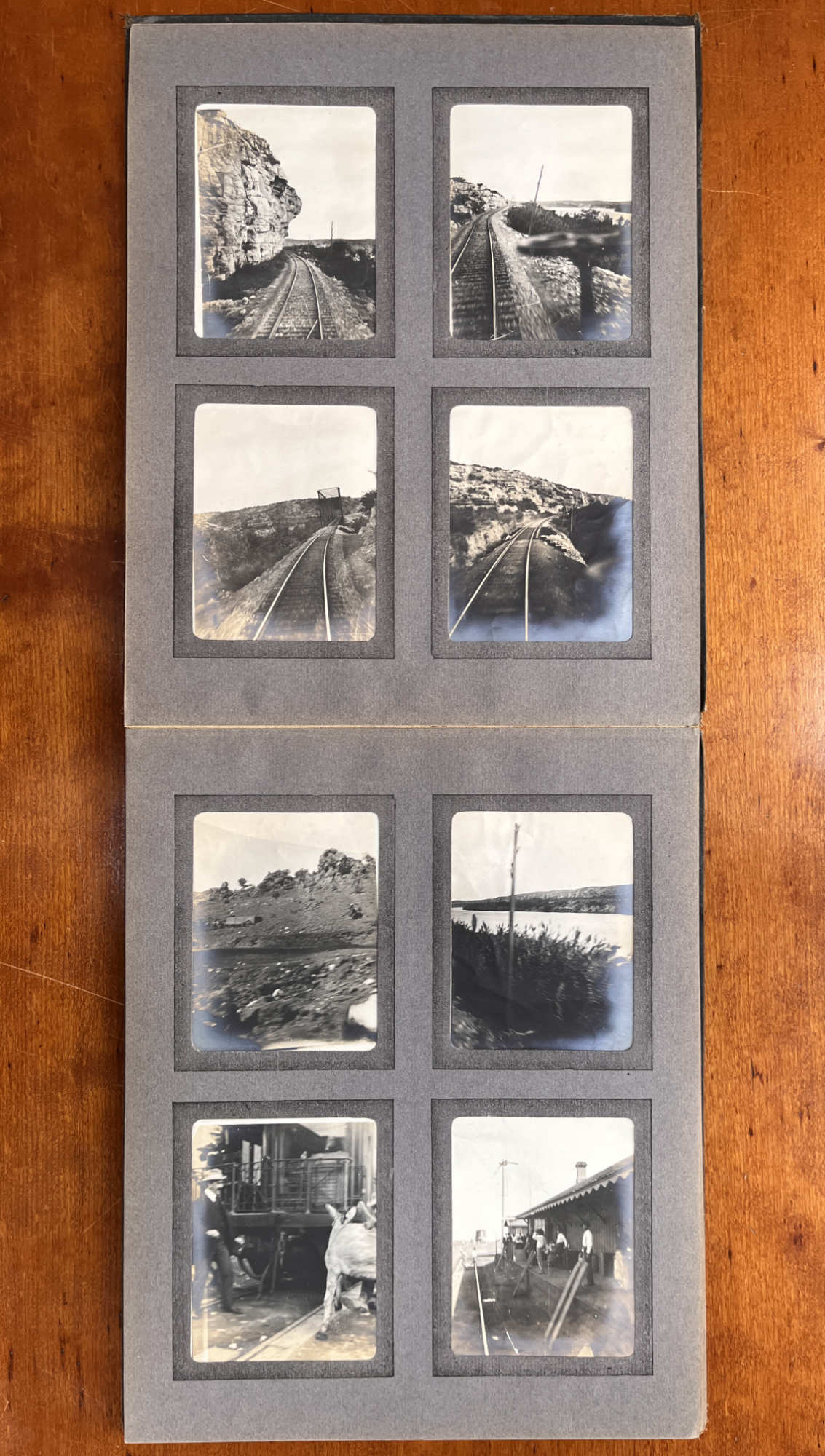
Many of the photographs in the album were of rail travel.
Without much trouble, I identified the recipient of the album—George Sloan Robbins (b. 1856, d. 1908). George lived most of his life in Bloomsburg, Pennsylvania and lived on Normal Hill in that town. In 1886, he married Mary Catherine Knapp (b. 1859, d. 1929). The couple had two children, both of whom died young: Katherine Marie Robbins (b. 1887, d. 1897) and an unnamed infant who was probably stillborn.
During the 1890s, George worked as a “general agent” lawyer for the Wirt Fountain Pen Company, which was one of the top pen manufacturers of that era. He was also involved in a number of business ventures and expeditions into the West. The Columbia County Republican recorded that he visited New York City on business as early as 1890, and the Columbian noted that in 1896 he was president of the Bloomsburg Beef Company for a few years. That same year he traveled to Mexico “as a representative of New York Capitalists” according to The Democratic Sentinel newspaper.
The man on the left may be George S. Robbins. He appears in a number of photos on the album.
It was probably through his New York City contacts that he met William Cornell Greene (b. 1852, d. 1911). Born in Wisconsin, Greene moved to southern Arizona in the late 1800s to find his fortunes. Just over the border, in northern Mexico, gold and silver had once been mined. Greene, through his knowledge of geology, sensed that those early miners may have left something of value in the ground—copper. In 1896, he and three other men incorporated the Cananea Copper Company to start mining in Sonora, Mexico.
That was the same year George S. Robbins went to Mexico on behalf of a group of New York capitalists, who were probably looking to invest in the operation. George must have been impressed with William Greene and the mine. When Greene took a controlling interest in the mine in 1900, The New York Times reported that George S. Robbins was on the board of directors for the newly renamed Greene Cananea Copper Company.
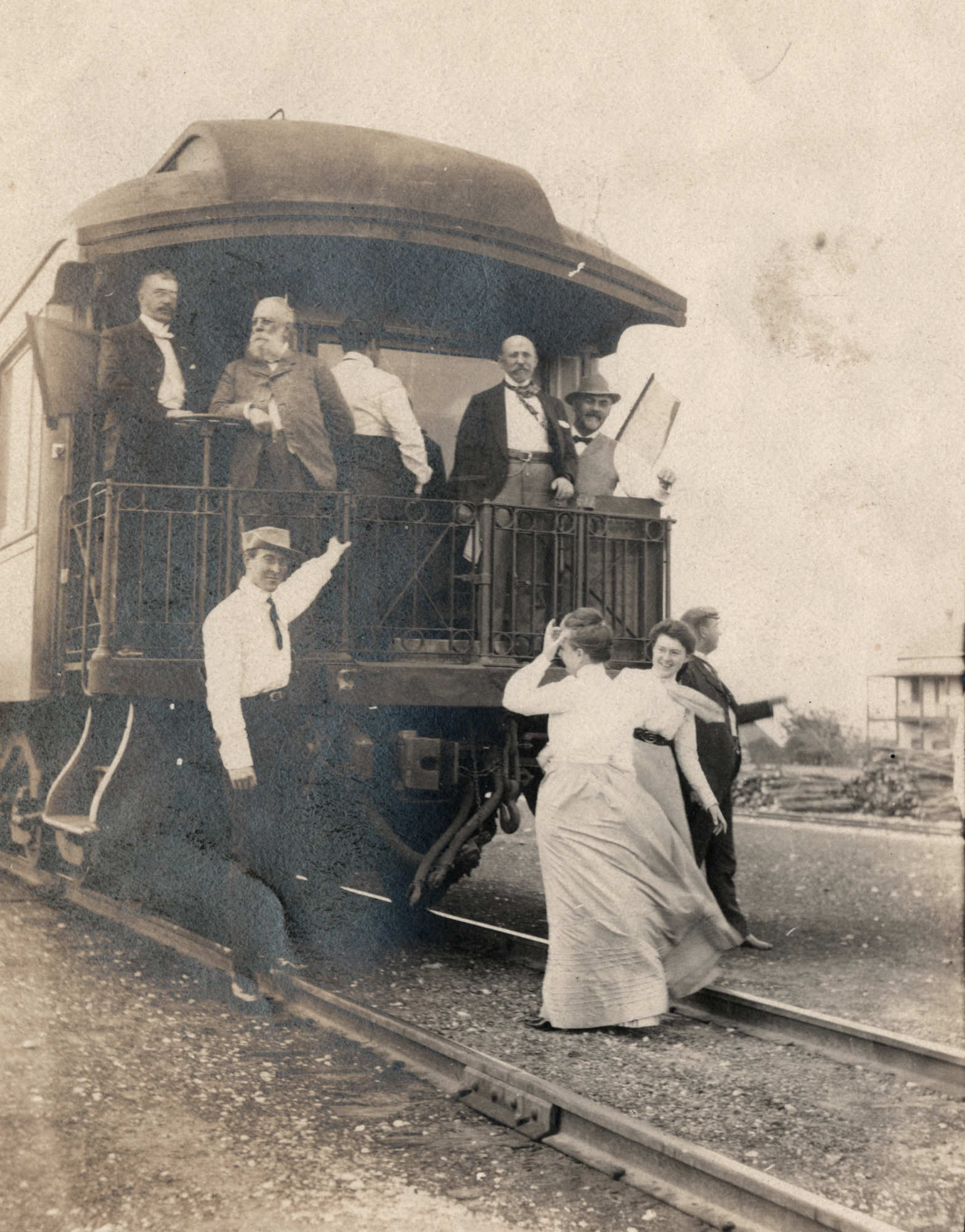
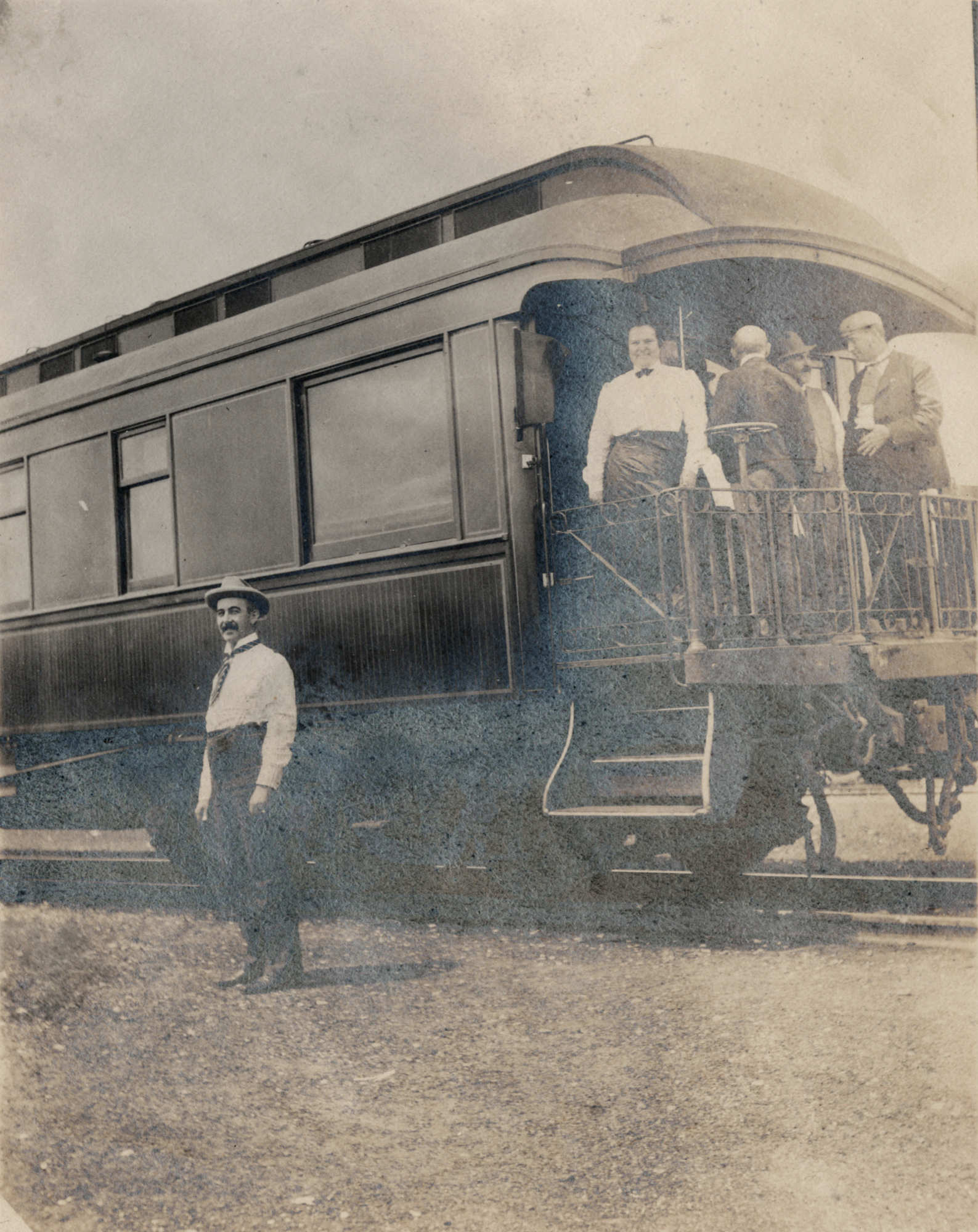
Members of the Cananea Mines trip by their Pullman car, 1902. U.S. Supreme Court Justice, Thomas Anderson is standing second from the right on the back of the car.
With his growing involvement in the mine and the need to raise money from New York financiers, George and Mary (Knapp) Robbins moved to New York City in early 1902 and resided on Broadway Avenue. It was from here that George organized a trip to Cananea copper mine in late 1902. On September 16, 1902, an article in the San Antonio Daily Light described some of the trip’s details:
The Sap Katy Flyer brought in a party of prominent people this morning, in a private Pullman, who are en route to Mexico to inspect some mining property in that country. Among those on board were: United States Senator W. A. Lattimore of South Carolina, Warren Foster, capitalist, New York, General Thomas H. Anderson, Washington, D. C., judge of the supreme court, District of Columbia, Jacob Weidman of New Jersey, one of the largest soap buyers in the world, Malcolm Gordon, Belfast Ireland, manager of the Barber Thread and linen works, Miss Irena Moore, niece of United States Senator Clark of Montana, Col. Henry Blount, vice president of the American Surety company, Miss Anderson, daughter of General Anderson.
George S. Robbins and wife, New York, Ludwig Reblick of the house of Seligman & Meyers, brokers, New York.
The party will spend a month in Mexico and should they return this route they will stop over in San Antonio for a few days.
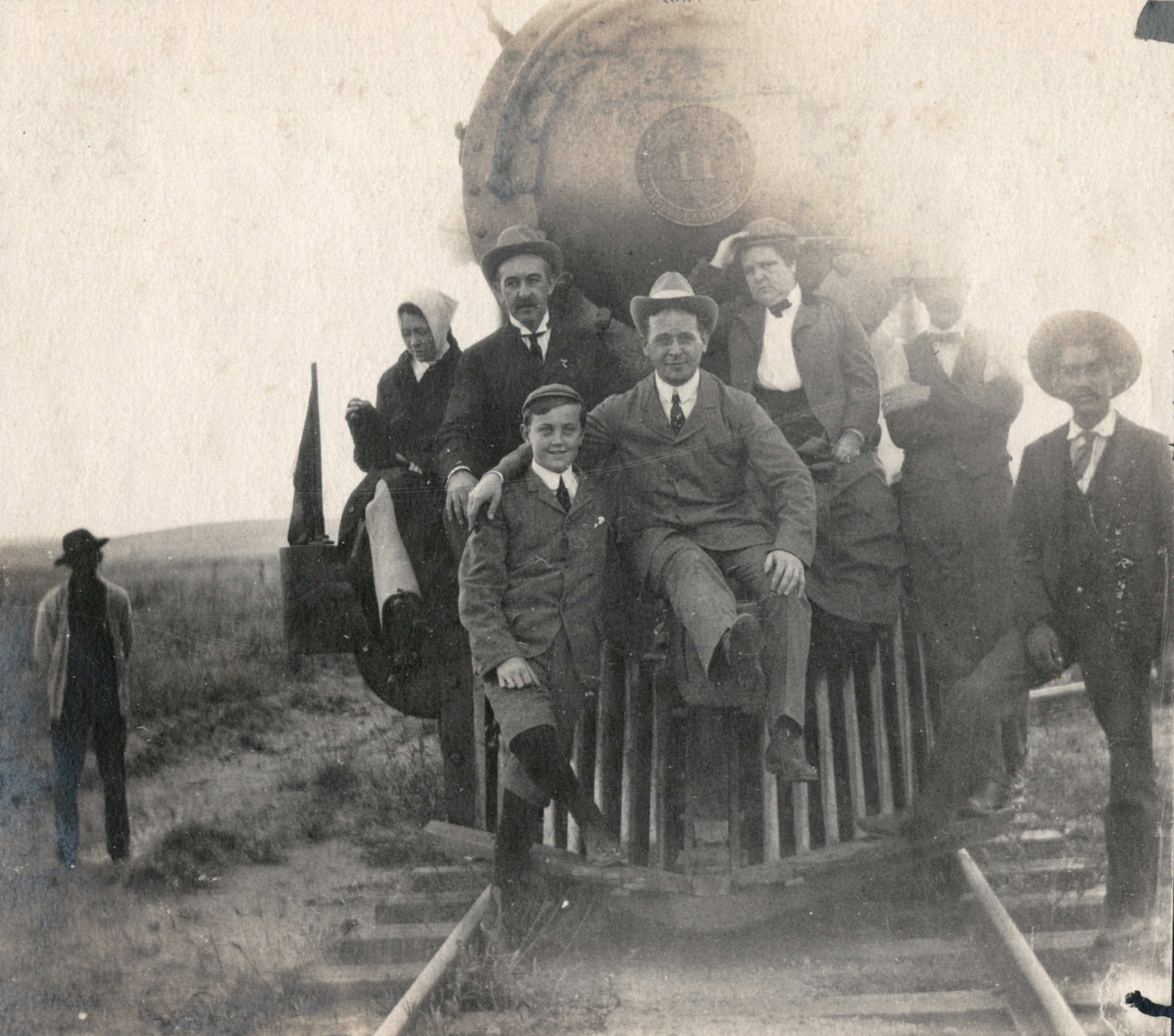
Members of the Cananea Mines trip pose on the front of their train’s engine. Ludwig Reetlish could be in the center front. Behind him might be George S. Robbins (left back) and his wife, Mary (right back).
From the above article, we learn that the 1902 trip took a group of prominent individuals to the Cananea Copper Mines, likely to drum up business and investment. It also reveals that George was traveling with his wife and the man who would later gift him the photo album, Ludwig Reetlish [Reblick]. According to the 1905 New York Census, “L. Redlish” lived in Manhattan and had been born in Russia. He worked as a stock broker, and would have been about 38 years old during the 1902 trip. Perhaps, Ludwig was tasked with selling stock in the mining operation to some of the wealthy travelers?
Once in Cananea, the party toured the mining operation and surrounding area. A few pictures even appear to show William Cornell, the mine’s owner, who would have pitched his business to potential investors. After leaving Cananea, the group continued on to California. One picture shows the Hotel Del Mar, which once stood in Long Beach, CA. Another, depicts the Mount Lowe railway in the San Gabriel Mountains, just north of Pasadena, CA.
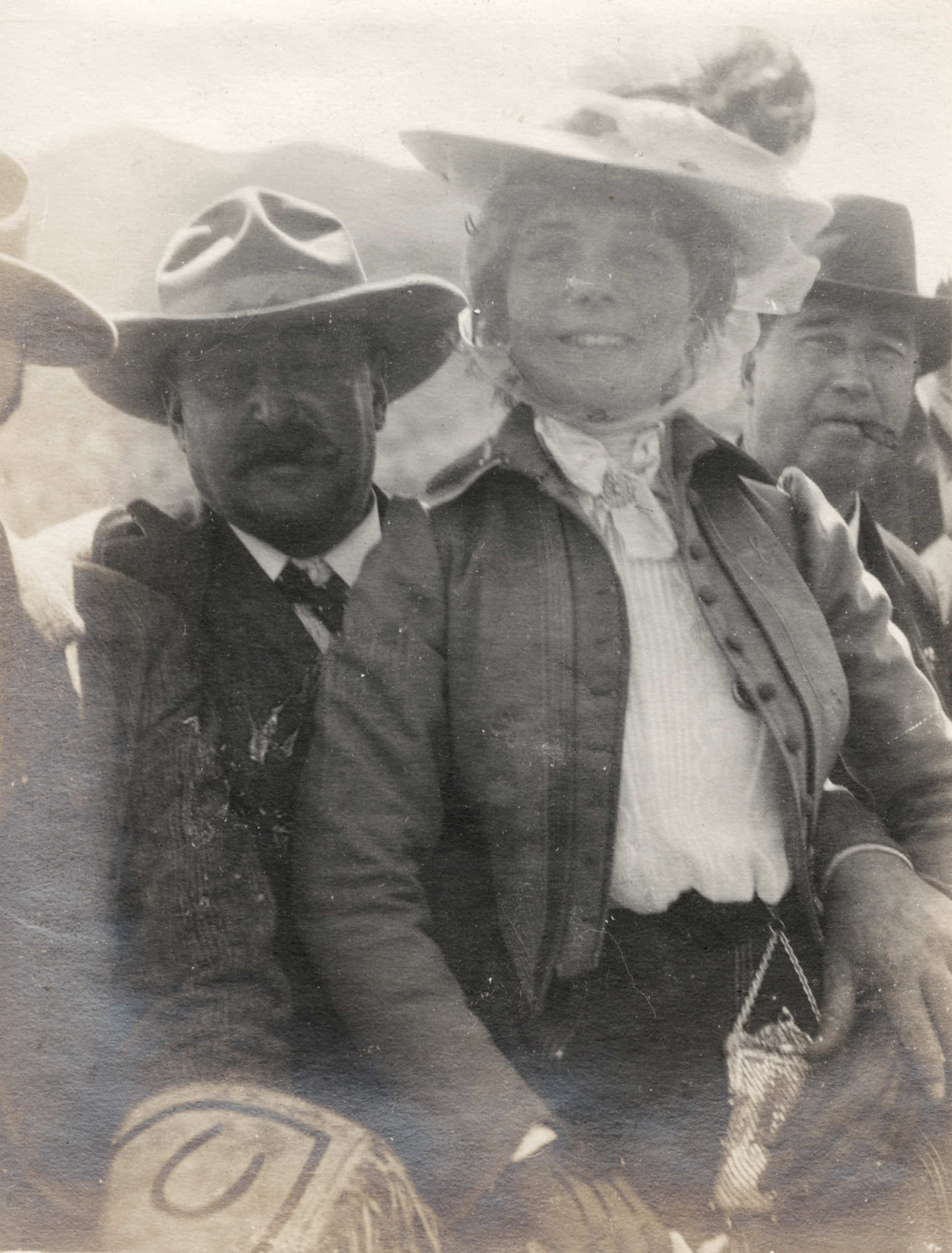
William Cornell Greene, the owner of the Cananea Mines, holds a young woman on his lap, 1902
Still another photograph, loosely placed in to the album, captures a hearth with some writing on the mantel above it. The full text isn’t visible in the image, but a quick search revealed that it read “
I was pleased with what I had learned about the album and the people in it. Yet, I had no idea how it ended up in a closet at my parents’ house. Initially, I thought George Robbins might have been related to one of Robbins lines that intermarried with the Hagenbuchs. However, after a few hours of research, I found a now apparent connection. Then, I reread his obituary.
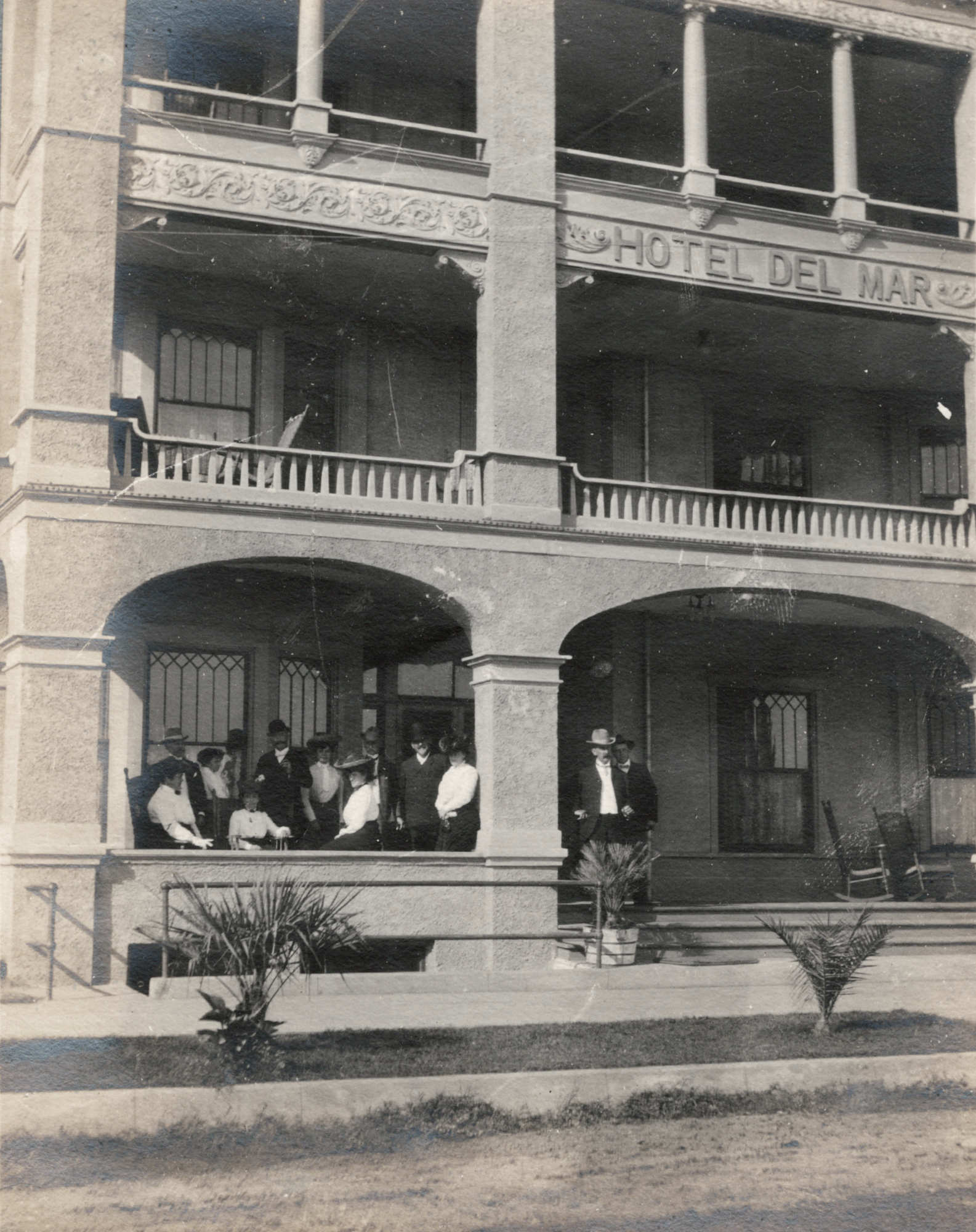
Members of the Cananea Mines trip stand in front of the Hotel Del Mar in Long Beach, CA, 1902
One of the pall bearers’ names stood out: H. B. Clark. Could this be Henry Bruce Clark (b. 1856, d. 1911), who was the son of Henry James Clark (b. 1829) and Sarah (Hagenbuch) Clark (b. 1833)? Henry Bruce Clark was a prominent businessman and Mason in Bloomsburg, just like George. He also appears to have attended attended the Bloomsburg Normal School with George’s half-brother, William Robbins. Perhaps Henry Bruce Clark received a few mementos from George’s widow—including the Cananea Mines photo album—after her husband’s death?
As noted in a preview piece, Hiram Hagenbuch (b. 1847), was the half-brother of Sarah (Hagenbuch) Clark. He named his son, Henry Bruce Hagenbuch (b. 1875), after his nephew, Henry Bruce Clark. Henry Bruce Clark never married and didn’t have any children, so when he died suddenly in 1911, his estate was distributed to relatives and the rest sold. Did one of his first cousins, such as Israel Hagenbuch (b. 1883), pick up the album?
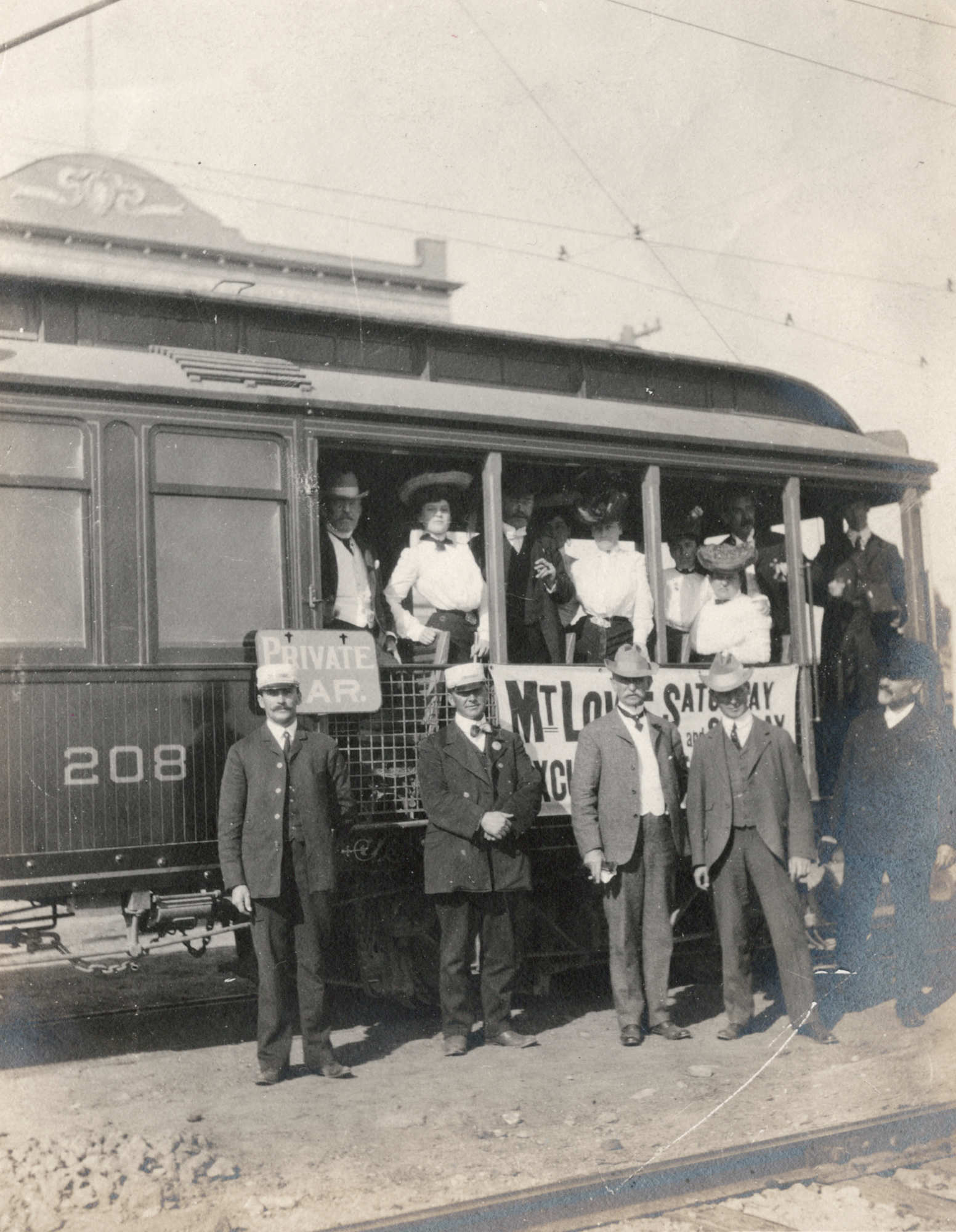
Members of the Cananea Mine trip board a private street car, outside the Hotel Del Mar. The sign on the side of the car indicates they are bound for Mount Lowe in southern California, 1902
After all, Israel did name one of his sons Bruce Hagenbuch (b. 1913). (Bruce later changed the spelling of his name to “Bruice.”) My father received pictures, papers, and other ephemera from Bruice’s sister, Julia (b. 1915), to be included with the Hagenbuch Archives. Did my father get the album from Julia but set it aside since it seemed to be unrelated to the Hagenbuchs?
Almost a century and a quarter since George S. Robbins’ trip to the Cananea Mines, we simply don’t know all the answers. However, thanks to my father’s dedication to saving historical artifacts and my dogged curiosity, we know a little more about this album and the people who appear within its photographs.