
What Is All This Nonsense? Part 2
It seems like everyday I encounter something about AI. Data center fights, cheating in schools, and realistic photo manipulations have all been the focus of AI-related news stories or online posts. It appears AI is here to stay, and the momentum behind it shows no signs of stopping!
One area where I can’t seem to get away from AI is in search engines. To be honest, I usually avoid the AI-generated summaries at the top of Google. However, I know an increasing number of people prefer AI to immediately answer their questions, instead of clicking on a search result link and visiting another website. I don’t deny that AI can be a time saver. But for genealogy, I question the complete accuracy of its answers, as I first wrote about in 2025.
AI models, such those used by ChatGPT, Claude, and Google, are trained on large amounts of data. This includes publicly available information on the internet, along with digital repositories of printed books. As the theory goes, the more data an AI model can ingest, the more accurate its responses will be.
Yet, what happens when relatively little has been written on a topic? While AI has mountains of facts and sources about George Washington’s life, relatively little has been written about our Hagenbuch ancestors. With this in mind, I did a several tests to see how various AI models would perform in 2026.
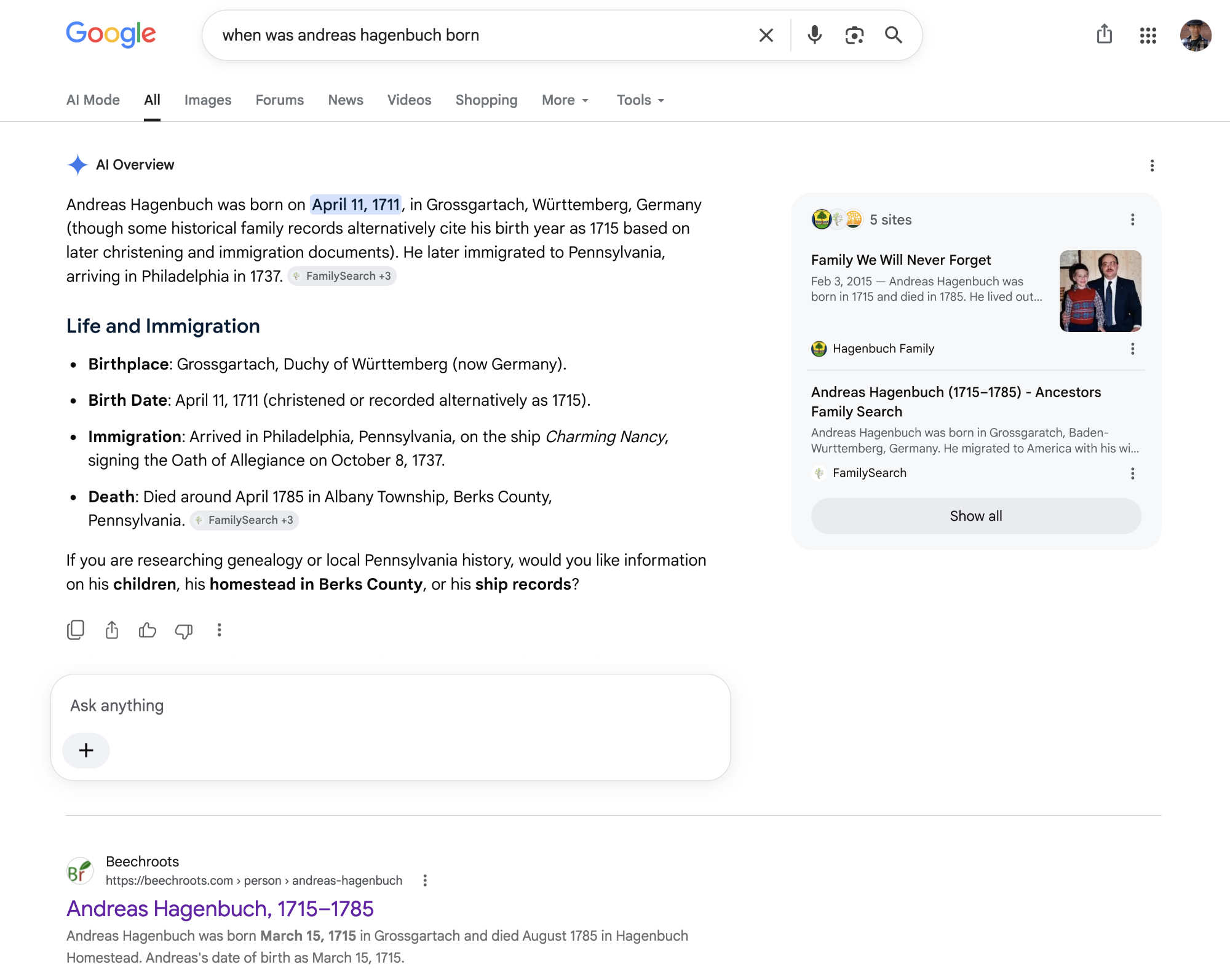
Google’s response to a question about when Andreas Hagenbuch was born
I first searched Google to discover when Andreas Hagenbuch was born. Google stated the following:
Andreas Hagenbuch was born on April 11, 1711, in Grossgartach, Württemberg, Germany (though some historical family records alternatively cite his birth year as 1715 based on later christening and immigration documents).
As we know from Andreas’ birth and baptism records, 1715 is the correct birth year for Andreas—not 1711—which is what Enoch Hagenbuch (b. 1814) cited in his family history. I tried searching Google again, and this time it responded with a different, improved answer:
Andreas Hagenbuch was born in 1715 (some records note April 11, 1711) in Grossgartach, Germany.
This answer was better, although it omitted the exact day of his birth: March 15, 1715. I decided to try ChatGPT to see how it would answer. It replied:
The best-supported date for Andreas Hagenbuch, the immigrant ancestor who arrived in Philadelphia in 1737, is: March 15, 1715, in Grossgartach (now Leingarten), Württemberg, Germany.
A church record shows that an Andreas Hagenbuch was born March 15, 1715 and baptized March 16, 1715. His parents were Hans Michael Hagenbuch and Christina Hagenbuch.
ChatGPT answered correctly, so I wanted to see what Claude would say. Claude stated:
The most well-documented Andreas Hagenbuch is the immigrant ancestor of the American Hagenbuch family, and sources give slightly different years for his birth. One genealogy record lists April 11, 1711 in Baden-Württemberg, Germany, while the Hagenbuch family history site states he was born in 1715 in Grossgartach within the Duchy of Württemberg, dying in 1785 in Albany Township, Berks County, Pennsylvania.
So depending on the source, it’s either 1711 or 1715 — the family’s own historical society (hagenbuch.org) consistently uses 1715 in more recent research, which likely reflects updated findings.
Claude’s answer was more like Google’s, noting both 1711 and 1715. Ultimately, it did conclude that Andreas was probably born in 1715. Still, my concern is that someone using Google who reads the first AI-generated response will walk away thinking Andreas Hagenbuch was born in 1711.
Frustratingly, the topmost search result in Google for when Andreas was born is a link to Beechroots.com. Beechroots includes Andreas’ correct birthdate, of course! If the AI summary was omitted on Google, most searchers would likely click to visit Beechroots and receive the correct answer to their question.
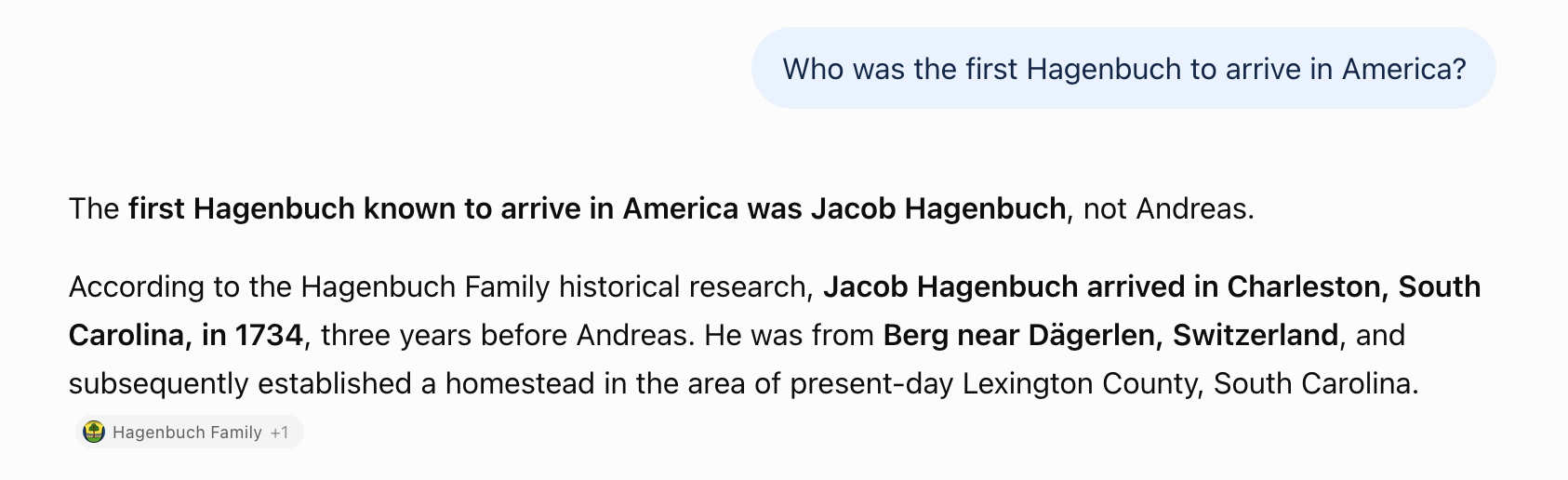
ChatGPT’s reply when asked about the first Hagenbuch who arrived in America
My next test was to see how AI models responded when asked to identify the first Hagenbuch who arrived in America. I queried Google, which noted the following:
The earliest documented Hagenbuch to arrive in America was Jacob Hagenbuch, who landed in Charleston, South Carolina, in 1:2:2].
This is mostly correct. However, Jacob Hagenbuch landed in South Carolina in 1734, not in “1:2:2]” as Google’s AI stated. ChatGPT and Claude did better, replying that the first Hagenbuch to arrive in America was Jacob Hagenbuch in 1734.
I wanted to try a more complicated question and asked all three AI models how many children Andreas Hagenbuch had. Here were their responses:
- Google: 12 children
- ChatGPT: 12 children
- Claude: 11 children
Here, two got it right and one got it wrong. Andreas Hagenbuch had 12 children that we know of. Claude actually explained how it arrived at the incorrect number of 11. It stated that since there is no primary source to support that Andreas had three wives (which is true) one of the 12 children should be removed from the total, producing a flawed answer.
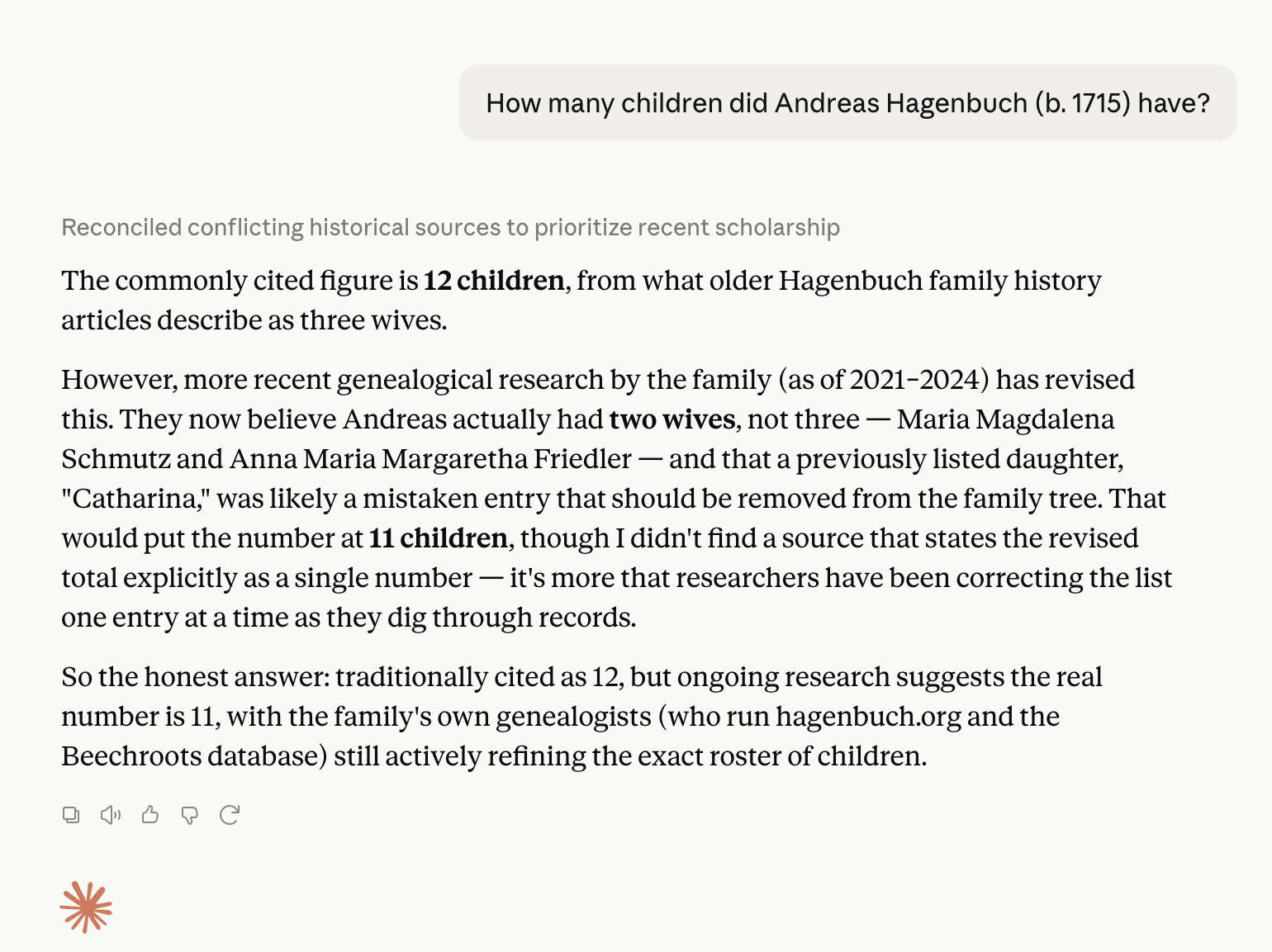
Claude’s convoluted and incorrect response to how many children Andreas Hagenbuch had
I wanted to ask the AI models one more question. I started with Claude and asked “What is the relationship between Andreas Hagenbuch (b. 1715) and Andrew Hagenbuch (b. 1785)?” It replied:
Andrew Hagenbuch (b. 1785) was Andreas’s great-grandson, not his son.
The chain is:
- Andreas Hagenbuch (b. 1715) → his son
- Michael Hagenbuch (b. 1746) → his son
- Andrew Hagenbuch (b. 1785) → grandson of Michael…
Wait, let me be precise: Andrew (b. 1785) is a son of Michael, which makes him a grandson of Andreas Hagenbuch (b. 1715) — not a great-grandson. So Andreas is Andrew’s grandfather, and Andrew is one of Andreas’s grandsons through his son Michael.
I found this response a bit ridiculous. Claude started off with a wrong statement, then corrected it partway through. In truth, Andrew (b. 1785) was the grandson of Andreas (b. 1715), not his great grandson. I also asked Google and ChatGPT the same question. Google got it right while ChatGPT got it wrong by stating that Andrew as the great grandson of Andreas.
With my test questions completed, I preformed a few experiments with AI image manipulation. The first one was something I had tried in the past—enhancing a low quality photograph. Supposedly AI tools are good at this task. I loaded a pixelated picture of Jacob Mosser’s (b. 1775) gravestone into ChatGPT to see if it could tease out any hard-to-read details. On the left is the original and on the right is the AI-enhanced result:
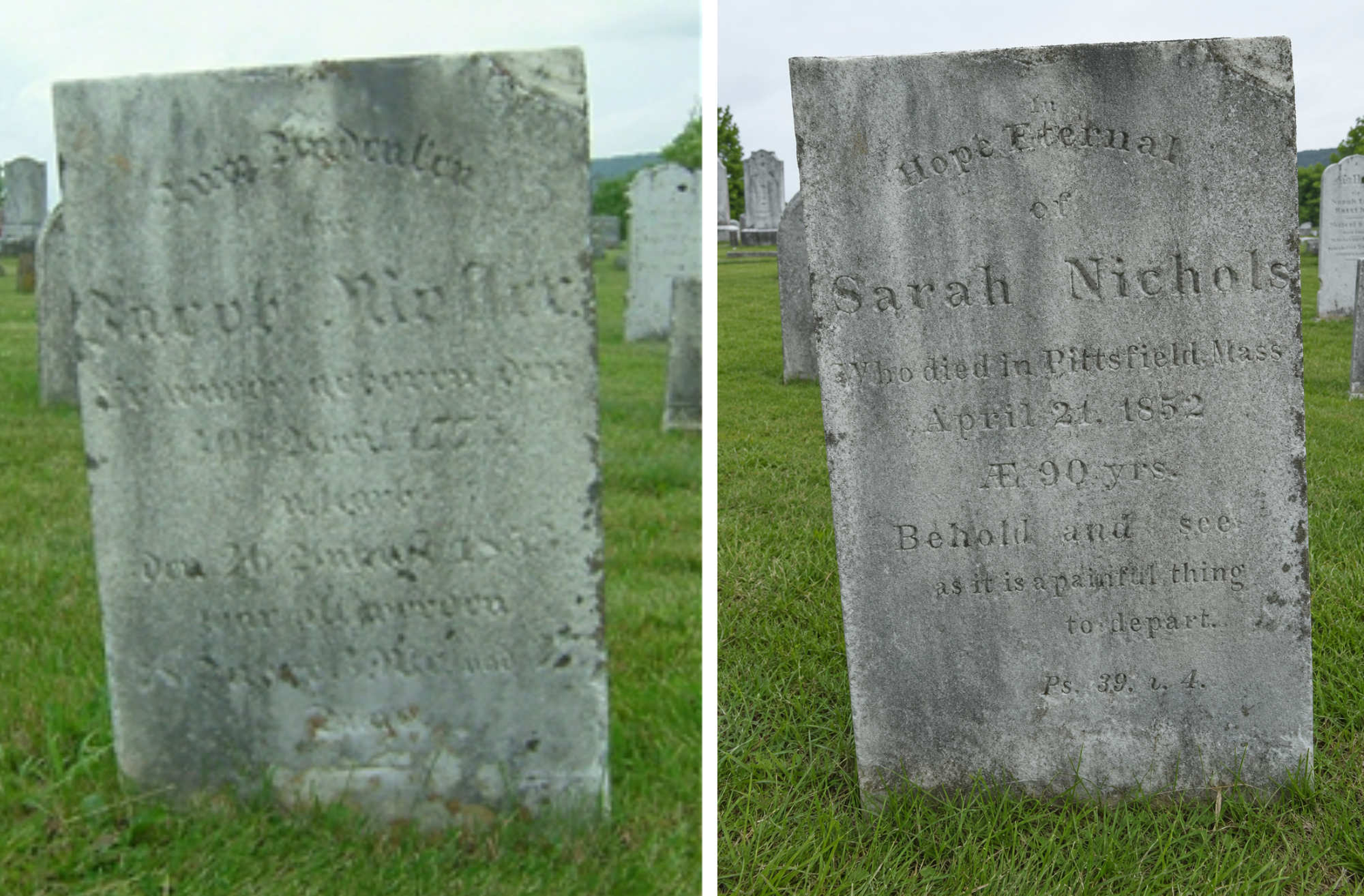
The original image of Jacob Mosser’s gravestone (left) compared to the ChatGPT enhanced version (right)
Instead of enhancing already-present details, the AI model kept the overall look and feel of the gravestone and added wrong information to it, including the name “Sarah Nichols.” I consider this a major drawback with using AI for image enhancements. It literally made up text and added it to Jacob’s stone!
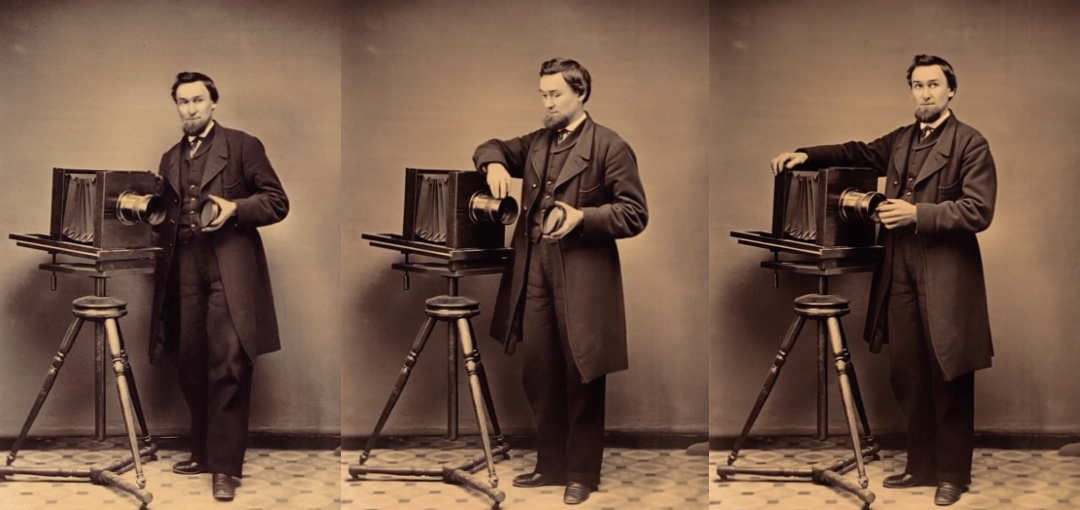
I then asked ChatGPT to colorize an 1875 image of Watsontown, Pennsylvania photographer, Henry W. Hagenbuch (b. 1834). In this case, AI proved more successful and the resulting image was in color and mostly true to the original source.
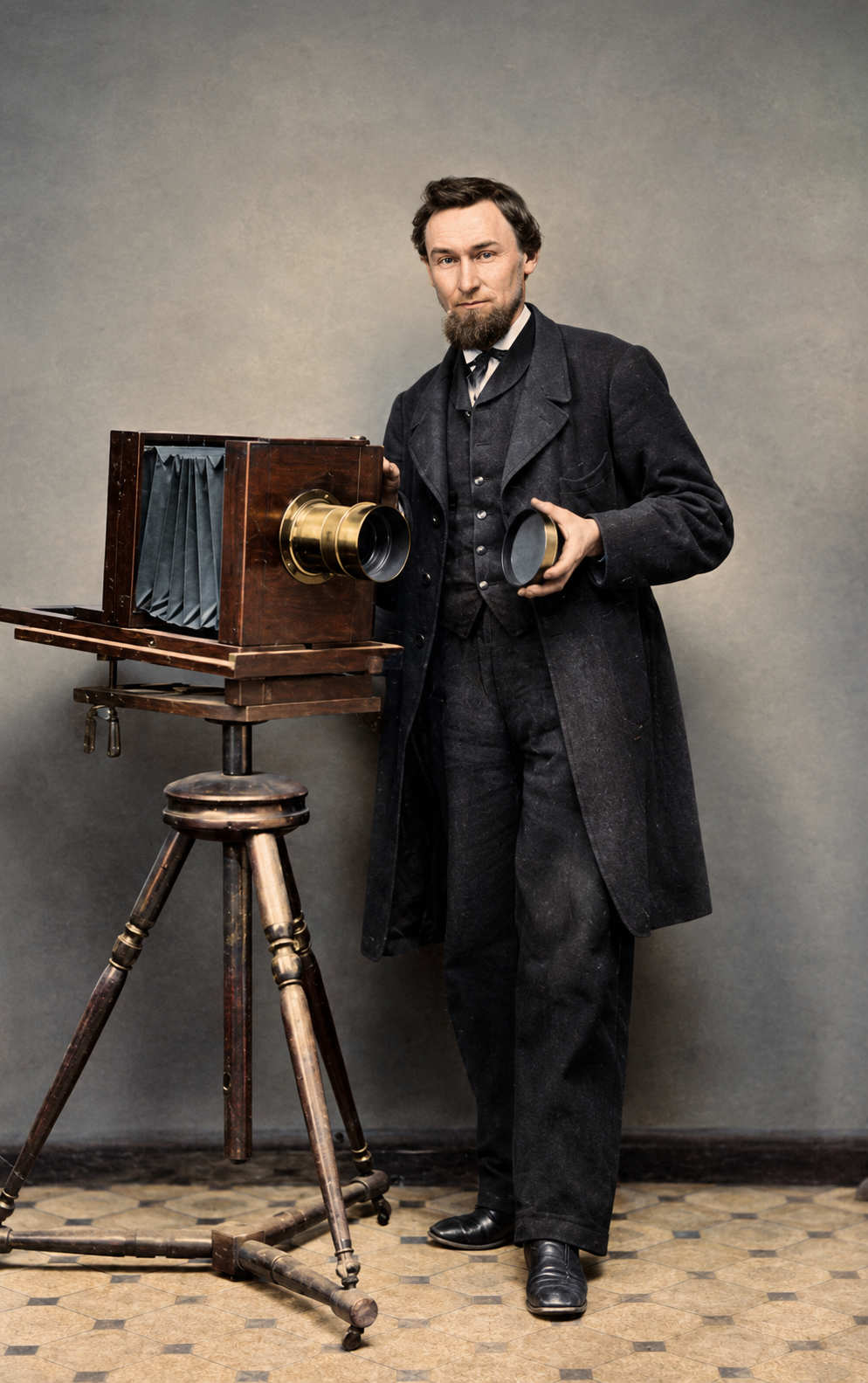
Henry W. Hagenbuch colorized by ChatGPT
My final experiment was to animate the 1875 image of Henry. I had heard that some genealogy tools, like MyHeritage, provide this type of AI functionality. I uploaded the picture of Henry to MyHeritage and asked it to create an animated “LiveMemory” of the photograph. The result was impressive, although it contained several errors. For instance, near the end of the video, Henry crumples up the camera’s lens cap as if it were a piece of paper!
As AI continues to advance, it is finding new uses in many different fields. With that said, the previous tests demonstrate its limitations, especially when applied to historic research and genealogy. Given AI’s tendency to produce factual errors and distort archival photographs, I plan to continue investigating our ancestors the old fashioned way—without overreliance on AI.
If you have had better (or worse!) success with AI, please leave a comment below.










Thank you for taking time to research and share your findings of the use of AI. I found it interesting that colorization was satisfactory yet interpretation of script faulty. Clearly research indications are that using multiple sources is critical for accuracy.
Many thanks,
Stephanie
Hi Stephanie. That’s an good observation. My guess is that there is a lot more training data for it to learn how to colorize images, while the number of sources about specific Hagenbuch facts is limited. This is why AI companies are always desperate for new data to feed into their system. It seems to improve accuracy, I guess?
I’ve been asked to use AI recently as part of my day job, and I have found the errors it makes inconsistent and perplexing. That was part of the inspiration for me revisiting it in genealogy.
Thank you Andrew, AI is new to us all and we do need to keep an open mind on what is correct and what is not.
Norma Kay