Flying with Honor: Major Glenn E. Hagenbuch, Part 1
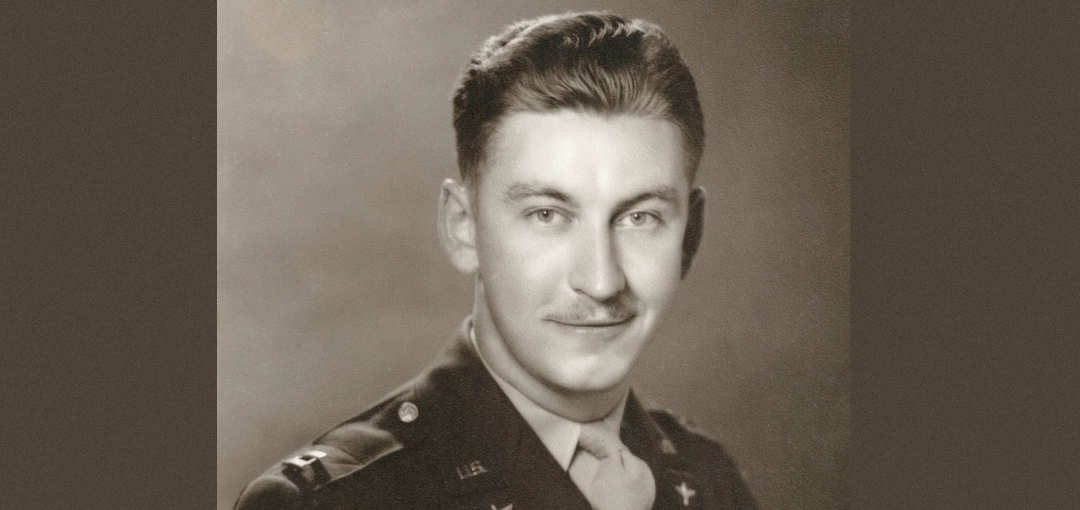
There are many Hagenbuchs who have served honorably in the United States Armed Forces, dating all the way back to the sons of Andreas Hagenbuch (b. 1715) during the Revolutionary War. These family members frequently set aside their personal ambitions and risked their lives to help their communities and country. One of the finest of these individuals is Major Glenn E. Hagenbuch—a World War II pilot who flew bombing missions over Europe.
Glenn Everett Hagenbuch was born on December 12, 1918 to Charles George Hagenbuch (b. 1884) and Cora Louise (Bartlett) Hagenbuch (b. 1889) in Ophir Township, LaSalle County, Illinois. His family line is: Andreas (b. 1715) > Michael (b. 1746) > Jacob (b. 1777) > Charles (b. 1819) > Albert Ira (b. 1859) > Charles George (b. 1884) > Glenn Everett (b. 1918).

Charles George & Cora Hagenbuch, c. 1950
In the 1920s, Glenn’s father took over the family farm in neighboring Waltham Township, LaSalle County, Ill. Here, Glenn and his two brothers, Charles Bartlett (b. 1913) and Melvin Albert (b. 1924), would grow up and learn about agriculture. For example, Glenn won second place in the LaSalle County 4-H Show for his “10-ear open pollinated corn” in October of 1937. He graduated from Ottawa High School in 1936 and from LaSalle-Peru-Oglesby Junior College in 1938. After college, he returned home and worked on the family farm. But Glenn wanted something more for his life.
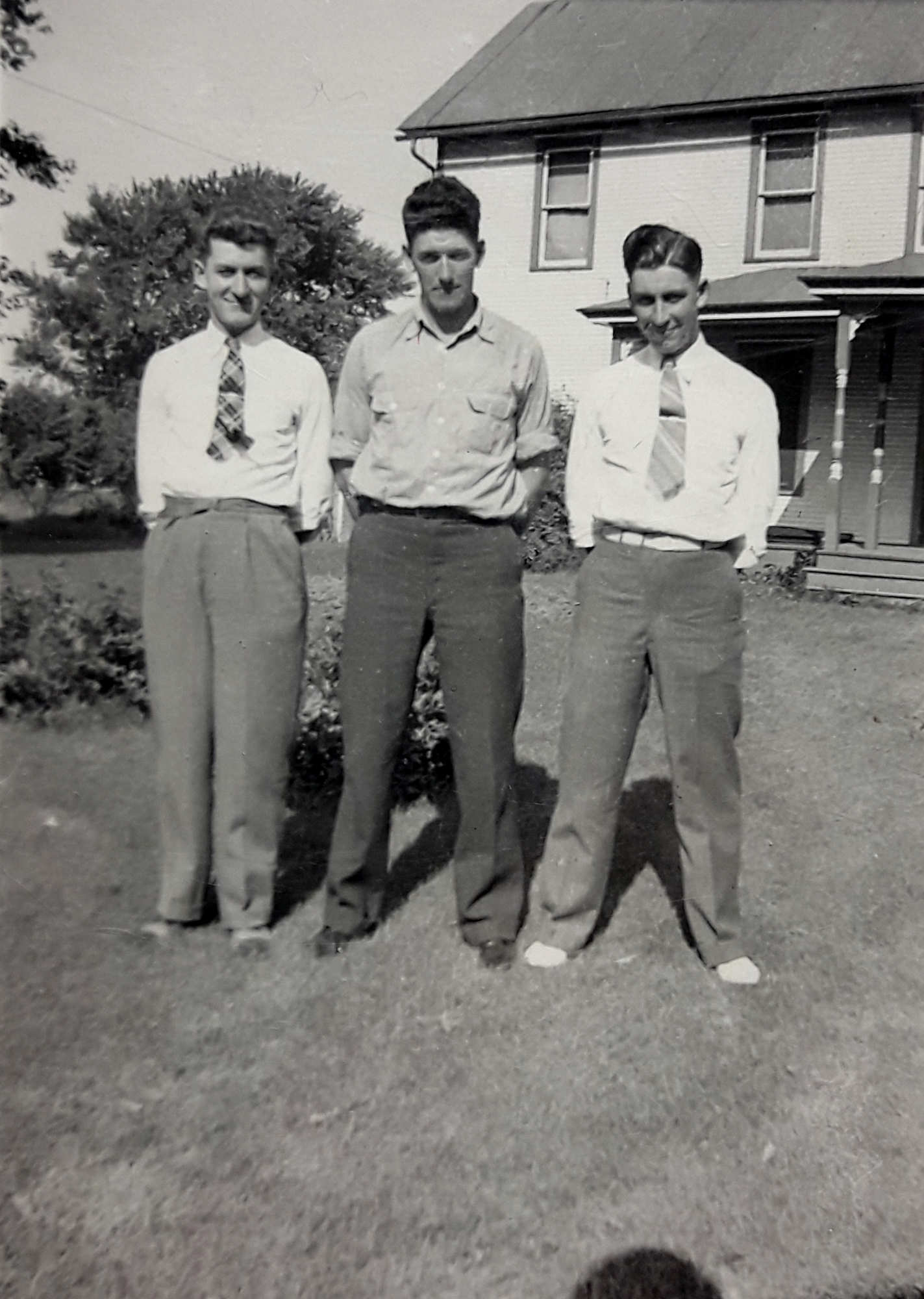
Brothers Melvin, Charles, and Glenn Hagenbuch, c. 1940
On September 9, 1940 he enlisted in the Army Aviation Cadet Corps with the goal of becoming a military pilot. He was sent to the Spartan School of Aeronautics in Tulsa, Oklahoma. After completing the school, he moved to basic training at Randolph Field in Bexar County, Texas, followed by advanced training at Kelly Field in San Antonio, TX. On April 25, 1941 he was awarded his pilot’s wings and commissioned a second lieutenant.
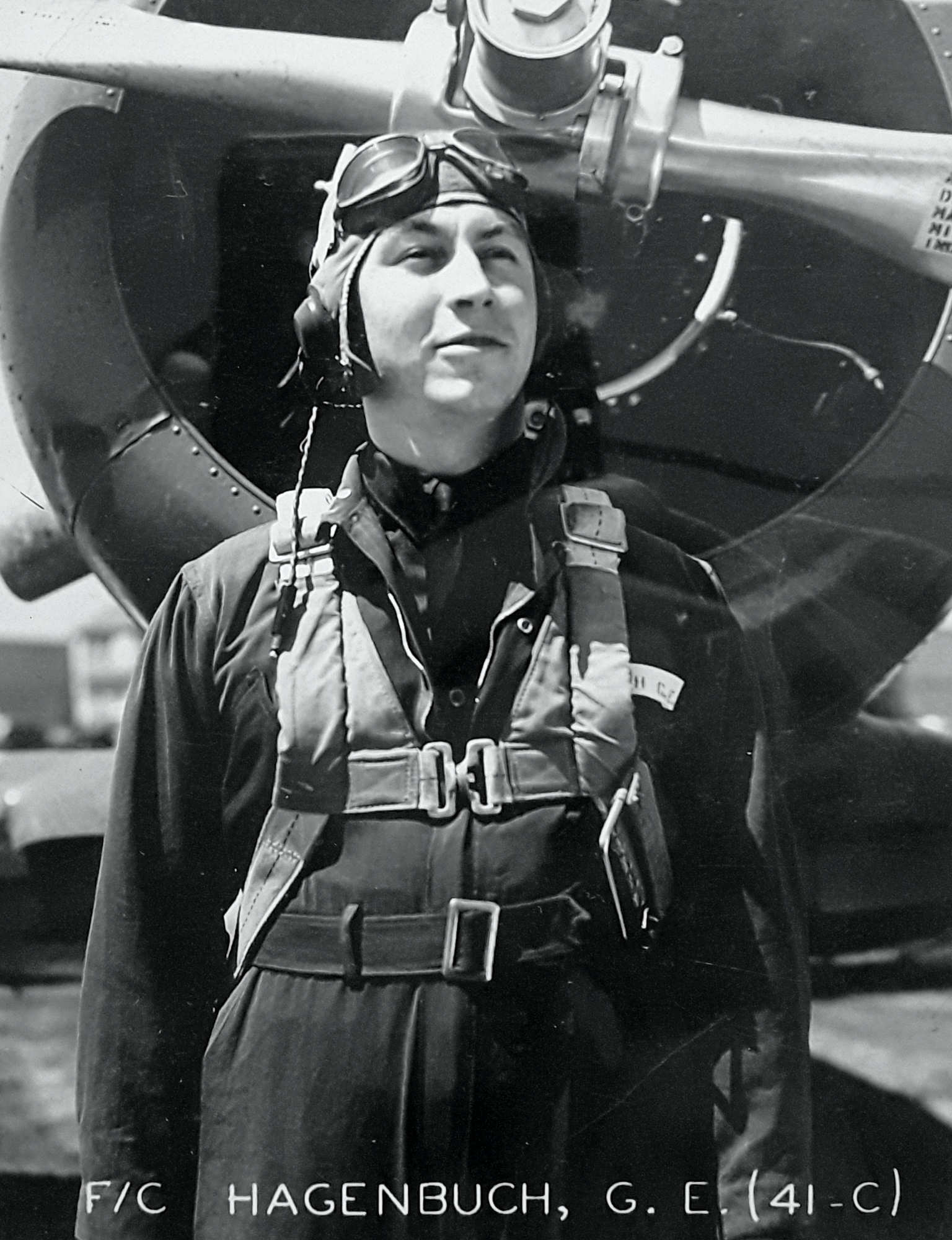
Flight cadet Glenn E. Hagenbuch shortly before being commissioned as a second lieutenant in the Army Air Corps, 1941
Glenn was transferred to Ferry Command, which was based in Bangor, Maine. Ferry Command was an effort during World War II to supply the United Kingdom with American-made aircraft. Primarily bombers, the aircraft were flown from the United States to Canada. From here, they were sent across the Atlantic Ocean to Northern Ireland. Glenn spent his time at Ferry Command piloting airplanes and learning how to conduct reconnaissance missions.
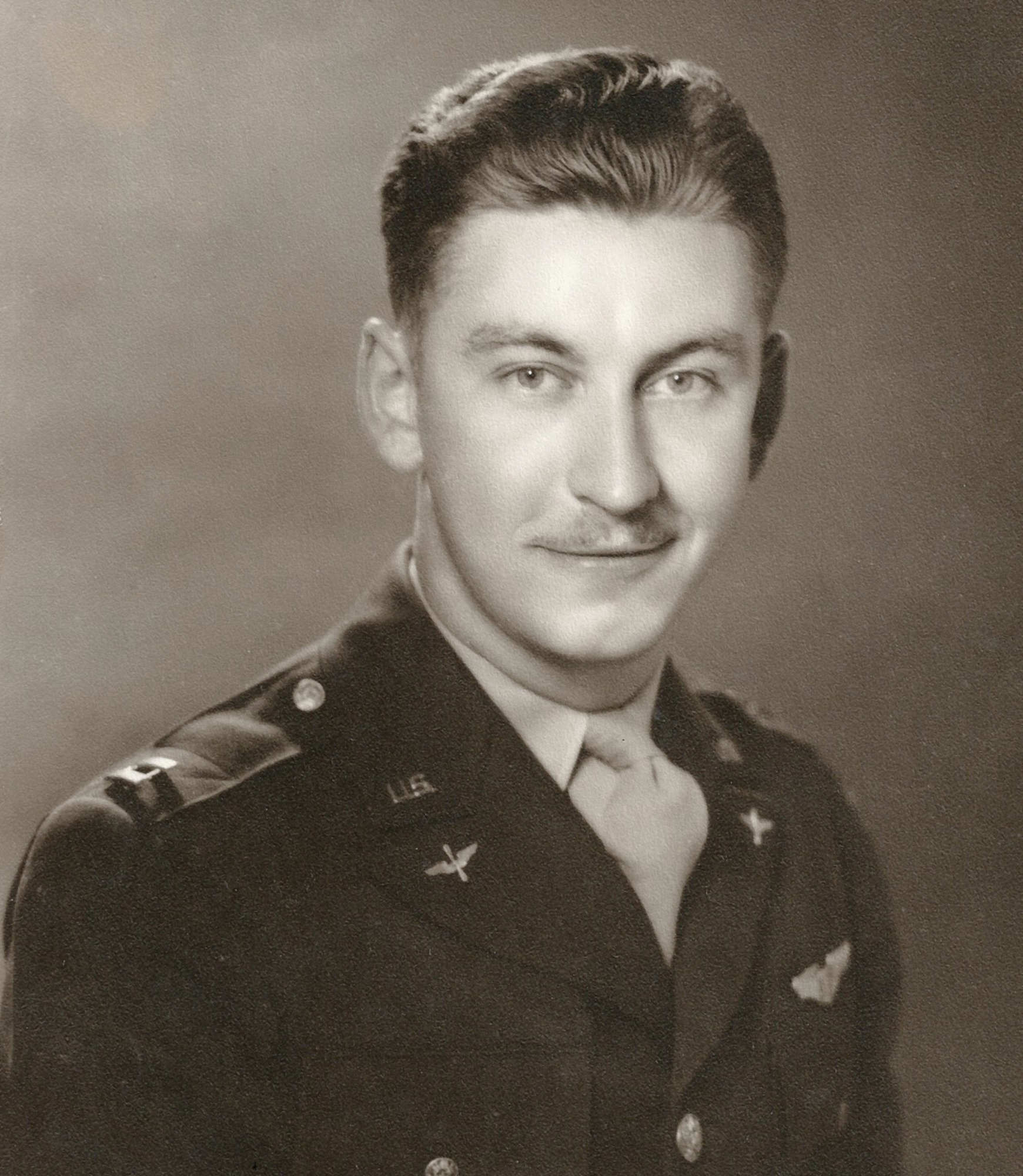
Captain Glenn E. Hagenbuch, 1942
In early November of 1941, he was recruited to join the American Volunteer Group, which was organized by the United States to oppose the Japanese invasion of China. Also known as the “Flying Tigers,” the pilots of the American Volunteer Group were trained to fly Curtiss P-40 Warhawk fighter planes. To join, Glenn resigned from the Army Air Corps and became a civilian again. Active United States military personnel were not permitted to participate in the operation since the U.S. was not at war with Japan. Glenn was sent to Los Angeles, California and was scheduled to set sail for Yangon, Myanmar on December 10, 1941. However, on December 7th Pearl Harbor was attacked by the Japanese—an event that changed the course of history for all Americans.
Glenn never boarded the ship and reenlisted in the Army Air Corps on January 12, 1942. He returned to Bangor, ME and was assigned to the the 13th Reconnaissance Squadron. In February, he was ordered to Langley Field in Virginia and promoted to first lieutenant on March 1st. He became an original member of the 427th Bomb Squadron of the 303rd Bomb Group “Hell’s Angels” on May 1, 1942 and was sent to Gowen Field in Boise, Idaho. His squadron would be trained to fly the B-17F heavy bombers. The above film, produced by the United States in 1943, provides an overview of the plane.
While in Idaho, he met Margaret LaVerne Spaeth (b. 1923), the daughter of Robert G. Spaeth (b. 1899) and Madge L. (Miller) Spaeth (b. 1903). The two began dating. On May 17th, he took leave and visited the family farm in Waltham Township. This would be his last time seeing his boyhood home.
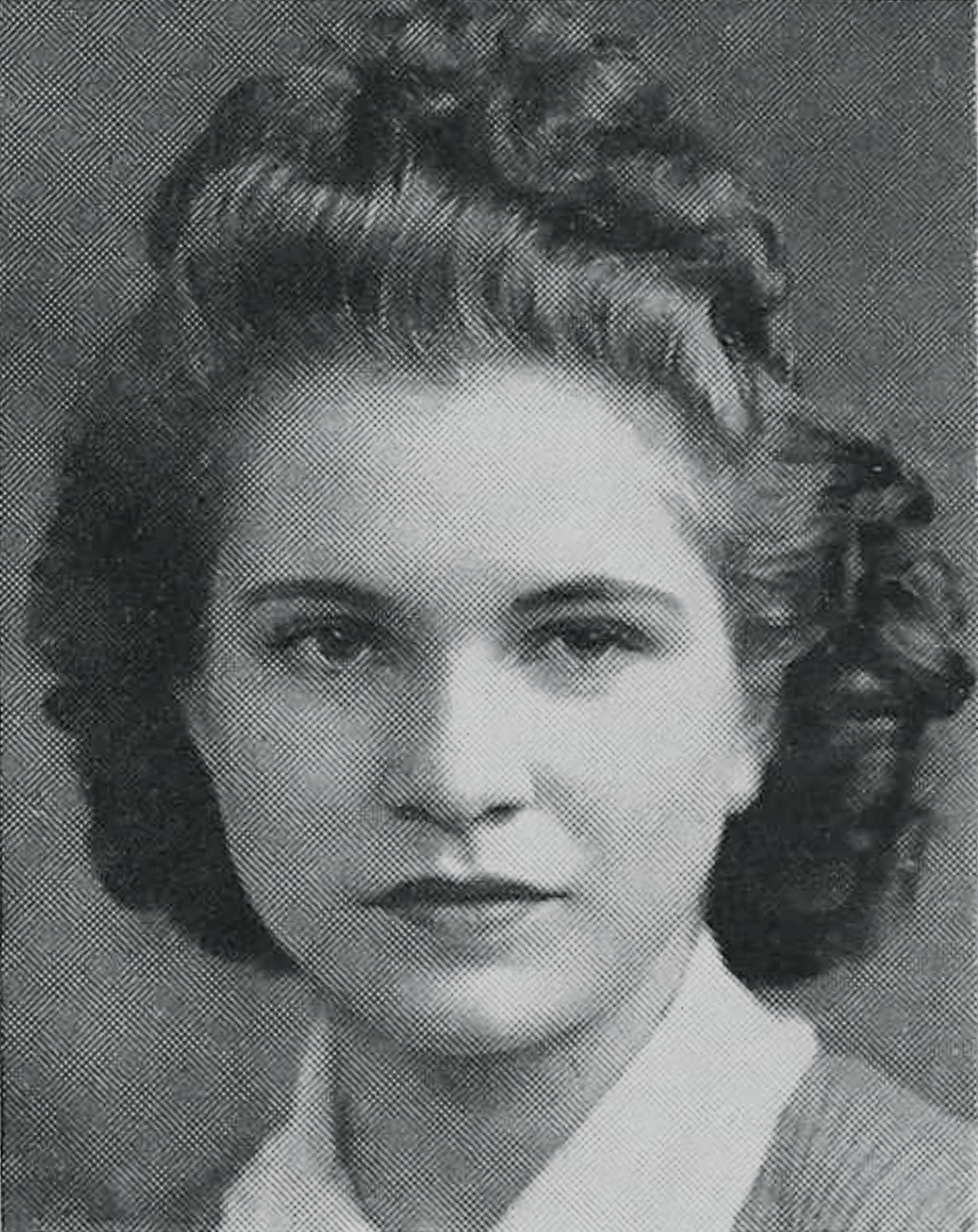
Margaret LaVerne Spaeth in 1941, from her high school yearbook
That summer, Glenn Hagenbuch was ordered to Biggs Field, El Paso, TX and assigned a crew. On September 1st, he was promoted to captain and shortly thereafter transferred with the rest of the squadron to Kellogg Field in Battle Creek, Michigan. He and Margaret were married at the First Presbyterian Church in Battle Creek on September 11, 1942. Glenn’s parents, Charles and Cora, visited the newlyweds on September 19th. Besides meeting his new wife, they wanted to see their son before he was ordered overseas.
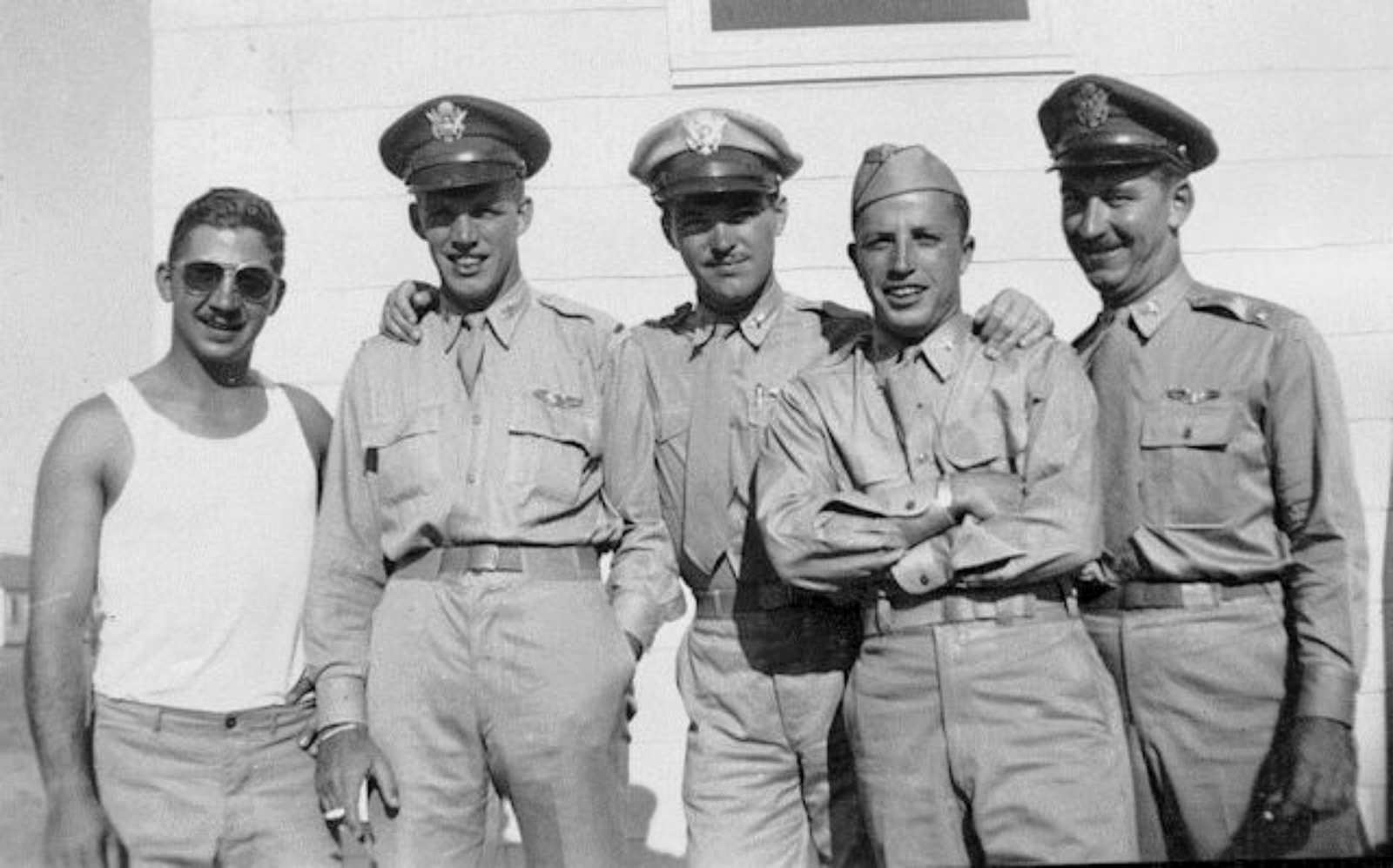
Glenn E. Hagenbuch (on the far right) at Biggs Field, August 2, 1942
On October 13th, Glenn’s squadron was stationed in Bangor, ME and proceeded to fly to Molesworth, England on November 1st. He piloted the B-17 bomber S-for-Sugar, serial number 41-24619. Although, Glenn liked to refer to his plane as “good ole 619.” The plane had a picture of Bugs Bunny standing on a bomb painted on its nose. Eventually, this illustration of Bugs Bunny would become the official emblem of the 427th Bomb Squadron in the 303rd Bomb Group of the Eighth Air Force. Naming, painting, and maintaining their aircraft was one ways servicemen kept their mind off their upcoming mission. In England, preparations were made to run bombing missions over Europe, right into the heart of Nazi-occupied territory.
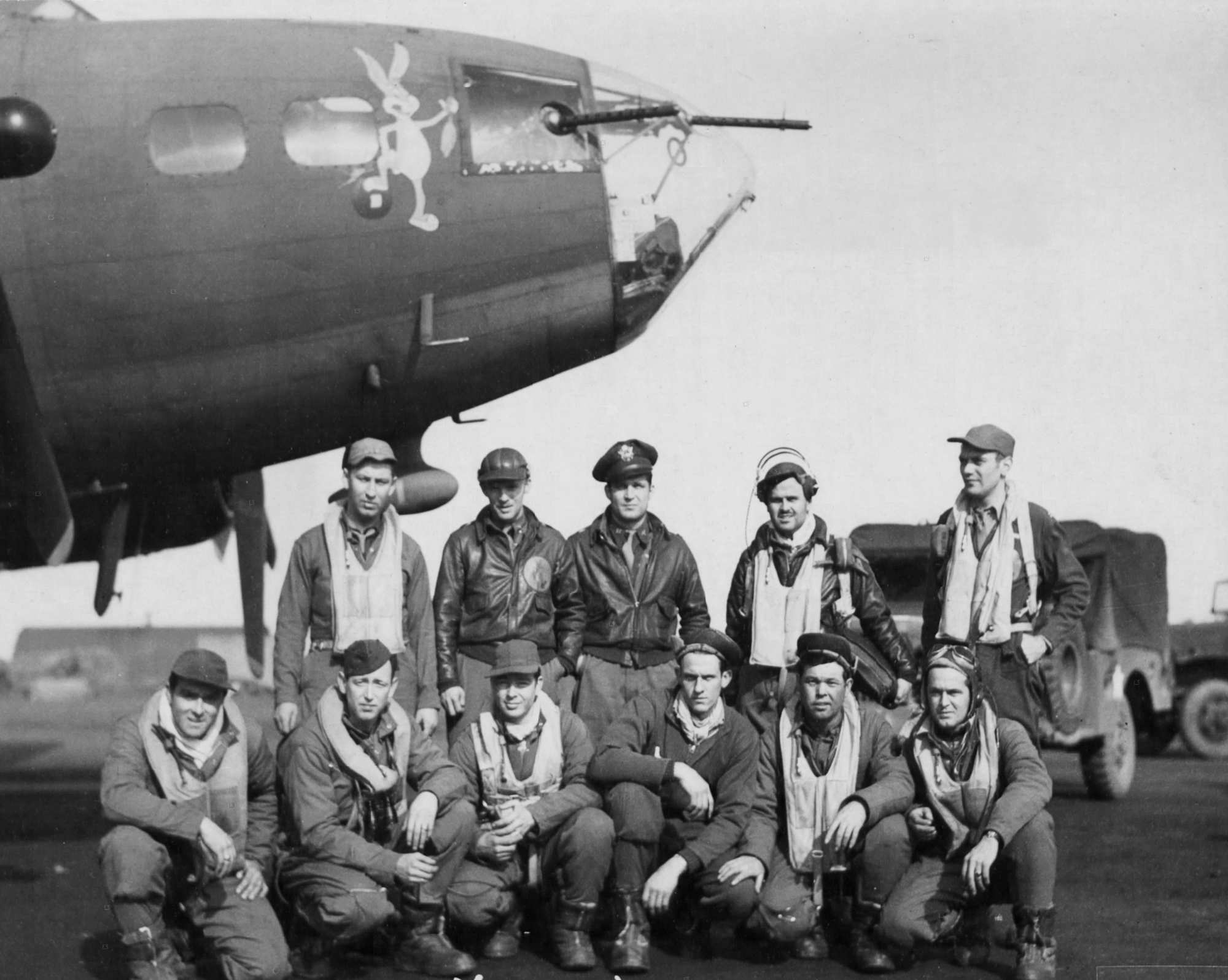
Glenn E. Hagenbuch (top row, far left) with the crew for the B-17 “S-for-Sugar” in 1943. Note the painting of Bugs Bunny on the plane’s nose.
As depicted in the 1990 film, Memphis Belle, the early B-17 bombing missions of 1942 were extremely dangerous, had numerous casualities, and led to many planes being destroyed. Some sources state that as many as 36% of all planes were lost. The Boeing B-17, known as the Flying Fortress, had four engines and a ten person crew. The crew including a pilot and co-pilot, bombardier, navigator, top turret gunner, radio operator, ball turret gunner, right side gunner, left side gunner, and a tail gunner. The B-17’s primary use during the war was to drop a payload of 4,800 lbs of bombs upon a specific ground target. Armed with five .30 caliber machine guns, the bomber could repel enemy fighter planes that were sent to stop it.
Ultimately, Glenn Hagenbuch would pilot or co-pilot 25 B-17 bombing missions between November 1942 to June 1943. His first mission took place on November 22, 1942 and was tasked with bombing the U-boat yard at St. Lorient, France. Unfortunately, he had to turn back due to mechanical failure. Still, many others were successful, and he piloted flights to drop bombs on the wagon works at Lille, the German air depot at Romilly-sur-Seine, and the locomotive works at Lille. By the end of 1942, American B-17s had destroyed or damaged numerous Nazi targets in France. However, great danger lie ahead as bombers would be sent over the heart of Nazi Germany in 1943. This would present Glenn with new opportunities, as well as lead to heartbreak and tragedy.
His story will continue in the second part of this series.
Special thanks to Ben Hagenbuch for providing documents pertaining to the life and service of his great uncle, Glenn E. Hagenbuch.