A Corn Cutting Conundrum: Examining an Unlabeled Photo
A few weeks ago a opened a briefcase I had found in the Hagenbuch Archives. Inside, it was full of papers, photographs, and other ephemera. One of those items was a picture of Boyd and Lula (Ruckle) Hagenbuch. But that wasn’t all.
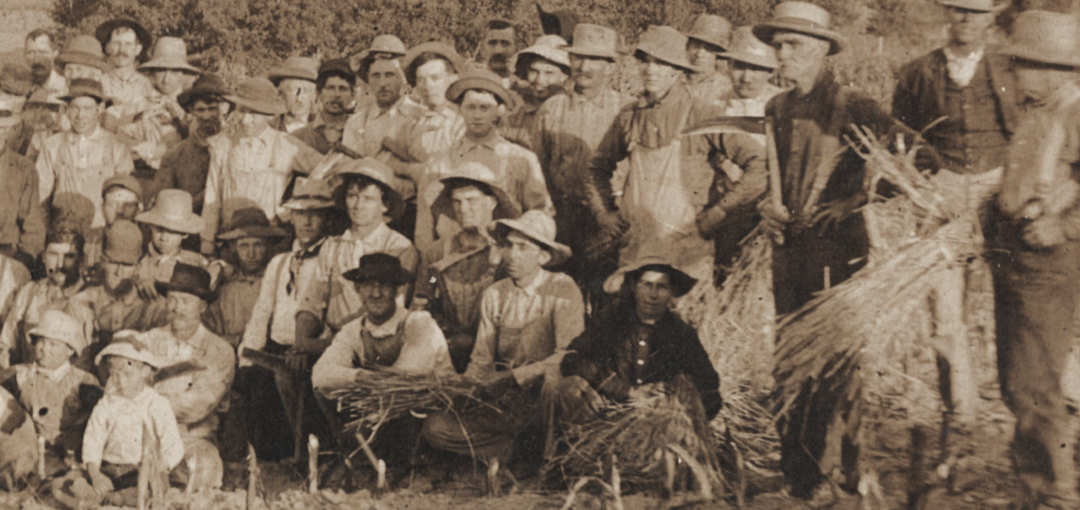
As I sifted through the briefcase, I came upon an old photograph depicting a group of men and boys standing in a corn field that had been cut. A number of men were holding corn cutters, while several more had sheaves of wheat or oats tucked under their arms.
In the foreground, the remains of the cut corn stalks were visible, along with a long shadow cast by the photographer. In the background, a house, barn, trees, and more fields could be seen. Even further in the distance, a thin line of mountains was discernible.
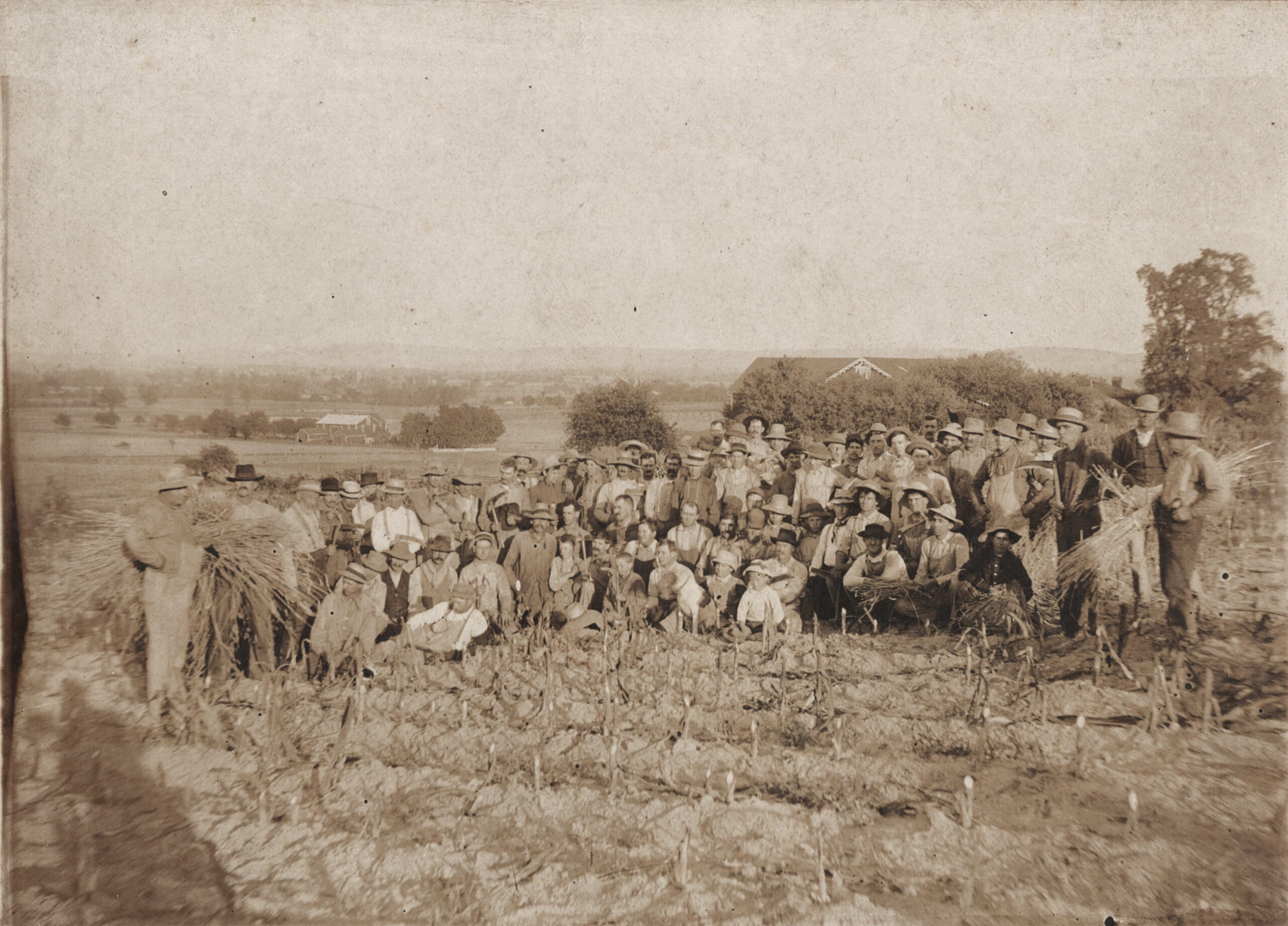
A group of Pennsylvania farmers along Limestone Ridge
“What a great picture,” I thought. I flipped it over to look at the back of the image. To my disappointment, it was unlabeled. I set the picture aside, thinking there wasn’t much of chance that I would learn its story. Yet, I couldn’t stop thinking about this photograph.
Though it was unlabeled, the image did provide one, important clue: It was found with a number of items once owned by my first cousin twice removed, Harold F. Sechler (b. 1923, d. 2018). If the photograph came from him, then it could be connected to the Sechler or Cromis families. (Harold kept pictures from both groups since he lived with his cousin, Myron Cromis [b. 1918, d. 1987].)
After looking at the background of the photograph, it did not appear to match the topography of the land where the Cromis farm was situated on Broadway Road outside of Washingtonville in Montour County, Pennsylvania. What it did remind me of, though, was the view from Limestone Ridge along Mexico Road. While I didn’t grow up in Moutour County, I was lucky enough to travel around the area with my father, Mark. He would point out various sites and tell stories from his youth.
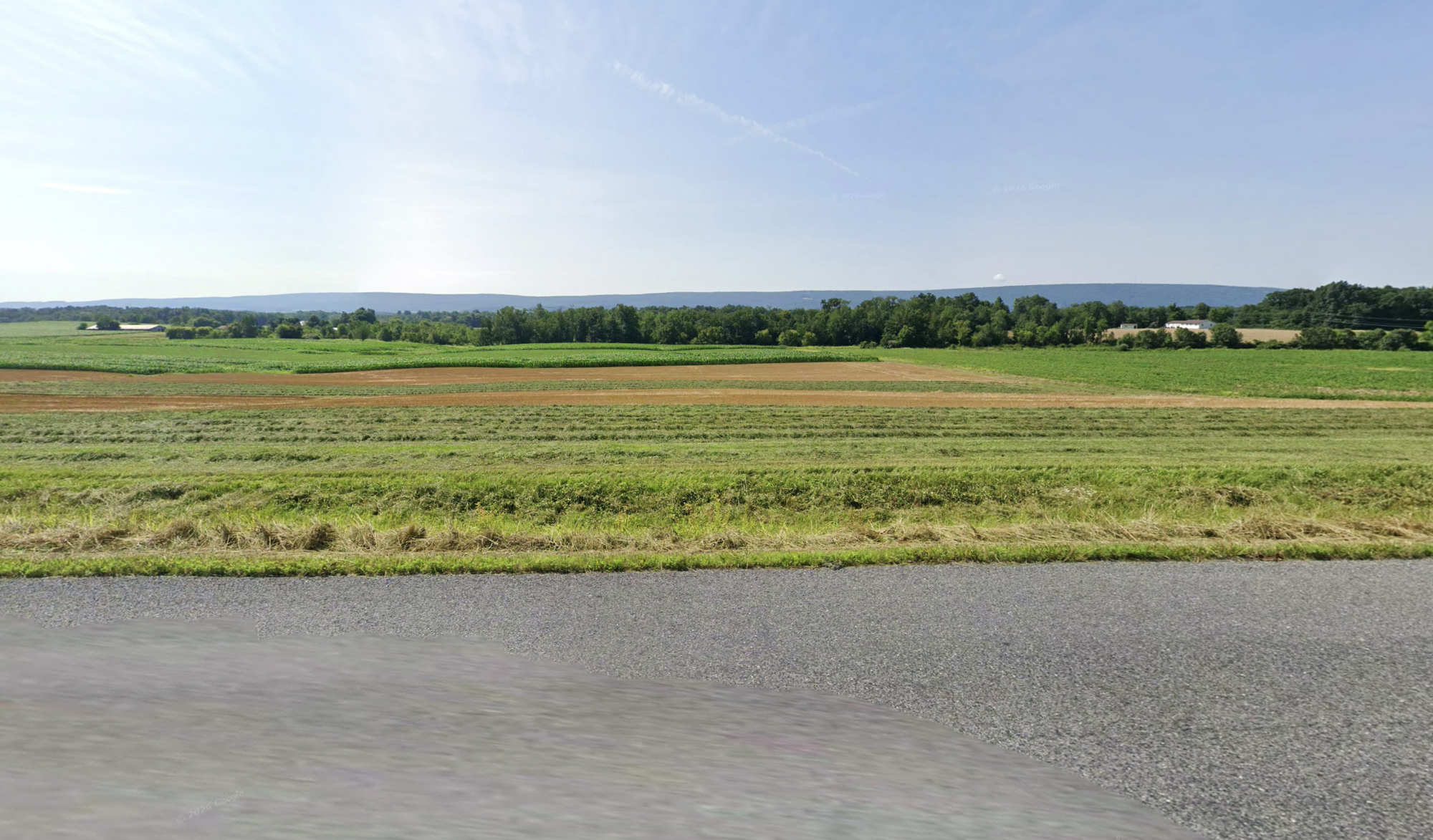
Facing south towards Pottsgrove at the base of Limestone Ridge, Montour Ridge is visible in the distance. Credit: Google.com
Looking more closely at the image, I surmised that the mountains in the distance were probably Montour Ridge, suggesting that the photographer was facing south when he took the picture. Indeed, the photographer’s long shadow is cast toward the left side of the frame (the east), meaning that the sun was setting in the west.
Now, I was getting somewhere, although I wasn’t entirely satisfied. I wanted to see if I could match the view from the field to an approximate location. I knew that Harold’s grandfather, Samuel Sechler (b. 1855, d. 1928), once owned a farm near Pottsgrove, PA which is in Northumberland County and directly adjacent to Montour County. Mexico Road runs along Limestone Ridge just to the north of Pottsgrove. Sure enough, when I looked at imagery from this locale, it closely resembled the background of the photograph.
Perhaps I could also match the barn and the house in the picture to modern-day structures? Unfortunately, after hours of searching satellite imagery and aerial photographs, I could not find them. While these buildings may still be standing, their design has changed.
I realized that I hadn’t yet considered when the photograph was captured. Noting the sheaves of grain, cut corn stalks, and trees full of leaves, the group must have gathered in late summer or early fall as the crops were harvested. Prior to the 1920s, corn was picked (or shucked) by hand. The remaining stalks were slashed close to the ground and bundled into shocks. The dried stalks were then used to feed livestock.
Eventually, the mechanical corn harvester was developed and fields no longer had to be picked or cut by hand. Based upon the men’s clothing and the corn cutters they are holding, the photograph was likely taken around the turn of the 20th century.
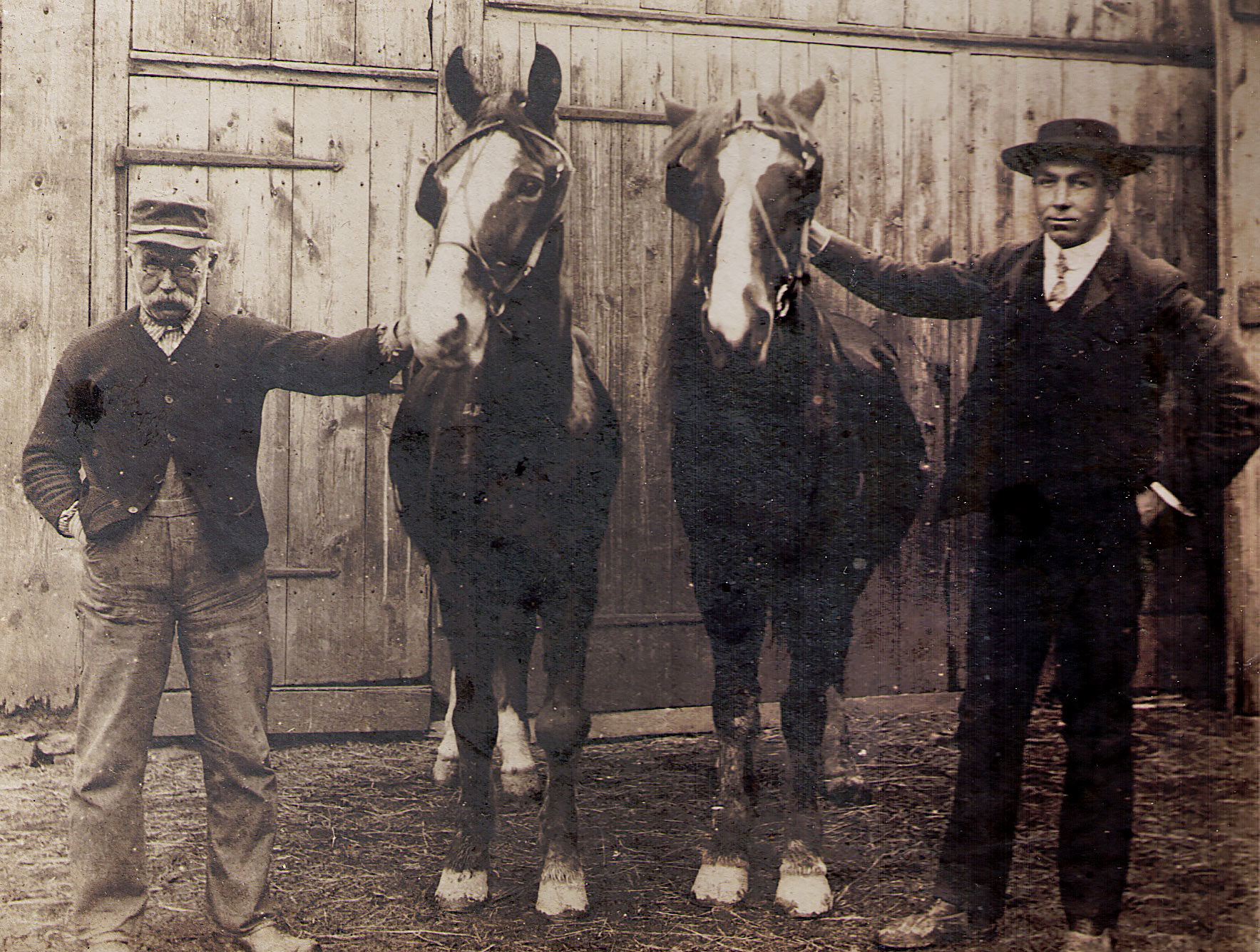
Samuel Henry Sechler (left) with his son, John McWilliams Sechler (right), c. 1925
I was pleased that I had come this far with the unlabeled picture. Still, I felt disheartened that I didn’t know if the photograph was from the Sechler side of our family. I looked over the picture several times using a magnification loupe, hoping to identify a face, but nothing caught my eye.
After a little while, I decided to scan the photograph at high resolution, enabling me to zoom in on individual people. This method proved superior to the loupe, and I could see each person more clearly. Now, there were a few faces that popped out. The first was a man with a large mustache standing behind the blade of a corn cutter. His head was tilted down slightly, and he was staring directly at the camera. Was this Samuel Sechler? I showed a later picture of him to my wife, Sara, and she agreed it looked a lot like him.
If Samuel was in the picture, might his son, John M. Sechler (b. 1885, d. 1928), be there too? Sure enough, in front of Samuel was a boy, crouching on the ground and holding a corn shock. He looked a lot like a teenage John. Since I knew that John was born in 1885, this would help date the picture to around 1900.
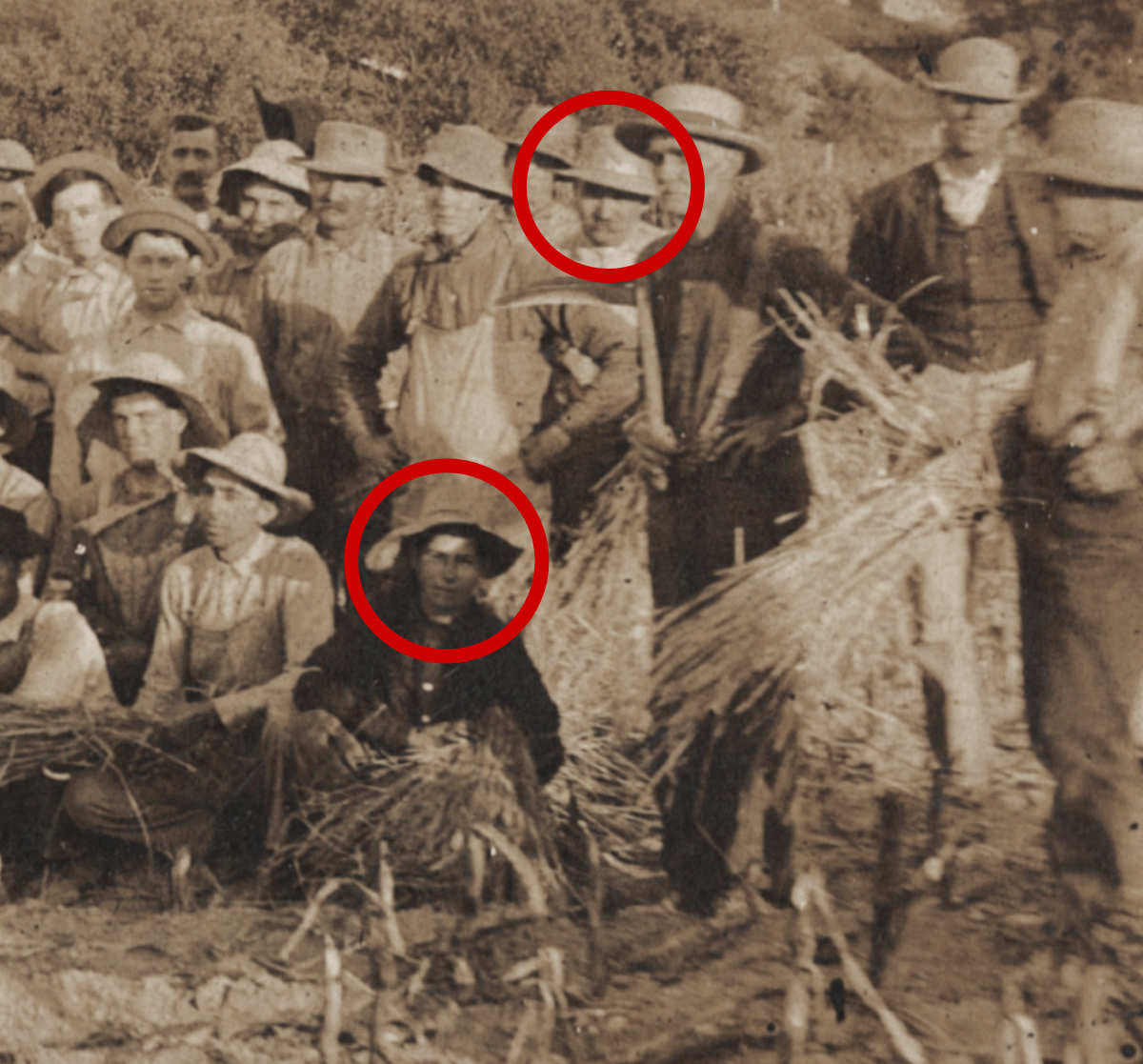
Are these the faces of Samuel H. Sechler (back) and his son, John M. Sechler (front)?
Finally, the unlabeled photograph had a story to tell. In late September about the year 1900, a group of farming men and boys gathered to harvest their crops: corn, wheat, and oats. After one particularly long day of work, they gathered in a field of cut corn stalks along Limestone Ridge.
Among those present were Samuel Sechler and his son, John. They lived on a nearby farm. One man had a camera, and it was decided a picture should be taken. Neighbors, friends, and relatives all posed together, some holding corn cutters and others with sheaves of grain. Copies of the photograph were later distributed to the farmers who appeared in the image.
Might some of the details in this story be incorrect? Absolutely. However, for an image that was unlabeled and almost forgotten, I feel confident that it will be enjoyed as part of the Hagenbuch Archives for generations to come.